
Some of these changes affect visibility. Others can directly influence lead quality, advertising costs, response time, booking rates, and ultimately revenue.
This report focuses on the 10 recent Google AI changes we believe matter most to roofing companies, what we are seeing across actual client accounts, and what contractors should do about them now.
Executive Summary: The biggest shift is that visibility alone is no longer enough. Roofing companies need to connect search and AI visibility with stronger local signals, faster lead response, better booking systems, accurate business information, and measurable sales outcomes.
This report covers the 10 most important recent changes and what roofing and exterior companies should do now to protect traffic, improve lead quality, increase appointment bookings, and generate more revenue.
The goal is no longer just more visibility. It is turning the right visibility into booked jobs and revenue.
Google AI Search Changes at a Glance
(Click a Change to Jump to its Section)
| Change | Potential Business Impact | What Roofing Companies Should Do |
|---|---|---|
| 1. Google Is Moving Local Services Ads Into Performance Max | Very High | Preserve historical performance data and establish a before-and-after baseline. |
| 2. Missing an LSA Call May Soon Cost You Money | Very High | Reduce missed calls and improve answer speed, routing, and availability. |
| 3. Google Is Making It Easier to Book Directly From Local Services Ads | High | Book qualified homeowners during the first conversation whenever possible. |
| 4. Google Search Console Now Shows AI Search Visibility | High | Establish a baseline and monitor which pages are receiving AI-driven visibility. |
| 5. Homeowners Are Searching With Longer, More Specific Questions | High | Continue focusing on core service concepts while answering more specific customer questions. |
| 6. AI Search Is Breaking One Question Into Many Searches | High | Build stronger evidence around services, products, credentials, locations, and customer needs. |
| 7. Google Maps Is Becoming More of the Destination | High | Treat your Google Business Profile as a conversion asset, not simply a ranking tool. |
| 8. Google Business Profiles Now Show Collected Info | Medium-High | Monitor information changes and keep website and business details accurate. |
| 9. GBP Data Reinforces the Importance of Category Precision | Medium-High | Use the most specific accurate primary category and meaningful additional categories. |
| 10. Google’s August Spam Update Was More Disruptive Than Normal | Medium-High | Prioritize unique intent, local proof, and quality over large quantities of repetitive content. |
If You Only Address Five Things Right Now
Roofing companies do not need to overhaul everything every time Google announces another update.
If time is limited, start with the changes that can most directly affect opportunities and revenue:
- Save Local Services Ads historical performance data before migration.
- Reduce or eliminate missed calls.
- Book qualified leads during the initial conversation instead of relying on callbacks.
- Establish a baseline for AI visibility in Google Search Console.
- Identify the services and markets producing your most valuable work and strengthen the evidence supporting them.
The objective is not to react to every Google update. It is to identify which changes affect whether the right homeowner finds your company, trusts it, contacts you, books an appointment, and ultimately becomes a customer.
1. Google Is Moving Local Services Ads Into Performance Max
What Changed
Google has begun migrating selected U.S. home-service Local Services Ads accounts into a specialized Performance Max campaign environment using pay-per-lead goals.
Roofing is included in the first phase.
The underlying lead model remains different from a traditional pay-per-click Performance Max campaign. Businesses continue paying for valid leads rather than ordinary clicks, and the ads can continue appearing across Google’s local search environment.
However, campaign management is changing. Historical reporting will not automatically transfer in the same way, weekly budgets are becoming daily budgets, and some existing bidding and management controls are changing.
Why Roofers Should Care
This is a major structural change to one of the roofing industry’s most important paid lead channels.
That does not automatically mean performance will improve or decline. It means roofing companies need to know what performance looked like before the transition so they can accurately determine what happens afterward.
What We’re Seeing With Roofing Companies
So far, we have not seen a meaningful change in lead performance or cost per lead from this transition.
None of the roofing accounts we manage have been fully converted into the new system yet, so it is too early to make a responsible before-and-after comparison.
What we are seeing is more friction around the platform itself. Google’s systems are becoming more secure, but at the same time, account access, verification, permissions, and platform behavior can feel increasingly glitchy.
That makes documentation even more important. If the platform changes, access changes, or reporting changes, you do not want your historical performance data trapped inside a system that is difficult to compare later.
What Roofing Companies Should Do
Export or document your existing LSA performance.
At minimum, preserve:
- Spend
- Charged leads
- Qualified leads
- Cost per qualified lead
- Lead categories
- Service areas
- Booking rate
- Estimate rate
- Sold jobs
- Revenue
Then create a clean:
Before Migration → After Migration
performance baseline.
Do not judge the new system by Google’s reported lead count alone.
The better question is:
Did the cost of acquiring a qualified opportunity or sold roofing job improve or get worse?
2. Missing an LSA Call May Soon Cost You Money
What Changed
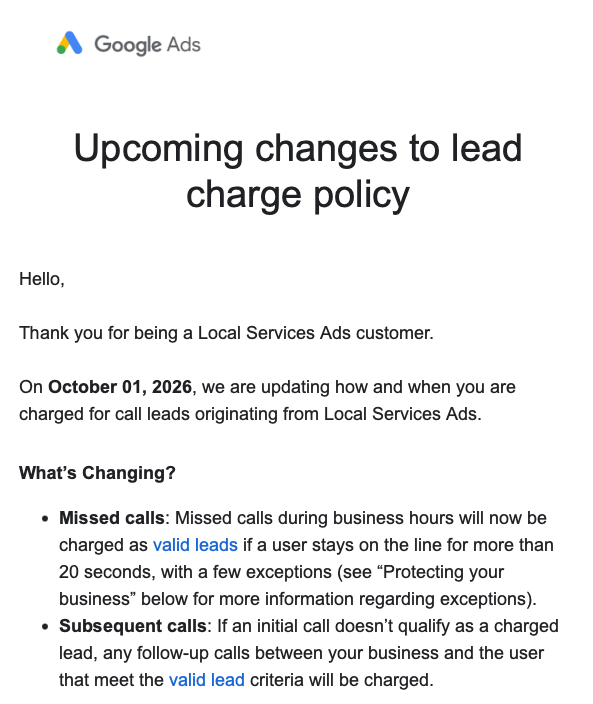
Beginning October 1, 2026, certain missed Local Services Ads calls can become chargeable when the caller remains connected long enough during posted business hours.
This makes an issue roofing companies should already care about even more expensive:
Not answering the phone.
Why Roofers Should Care
We have been telling roofing companies for years that someone needs to answer the phone quickly, ideally within about 20 seconds.
That person could be a receptionist, a trained call center, an AI voice agent, a salesperson, or another qualified team member.
What does not work well is a voicemail system or a round-robin setup that rings multiple people for an extended period and eventually asks the homeowner to leave a message.
By then, the opportunity may already be gone.
A homeowner looking for a roofing contractor is often contacting more than one company. Calling back later does not recreate the original opportunity.
What We’re Seeing With Roofing Companies
During 2026, we discussed missed calls repeatedly during monthly meetings with approximately 10 roofing sales teams and reviewed lead behavior across roughly five client CRM systems.
We asked sales teams a simple question:
When you miss a call and call the homeowner back, how often do you actually get them on the phone?
The answer was remarkably consistent. Most reported reconnecting with only about 40% to 50% of missed callers.
That means if 10 people call and nobody answers, the sales team may reconnect with only four or five.
The next question was even more important:
Of the people you reconnect with, how many still need you?
The teams estimated that approximately 75% to 80% had already moved on, booked someone else, or no longer needed the service by the time contact was reestablished.
In practical terms, the pattern looked roughly like this:
10 missed calls → 4–5 people reached on callback → Approximately 1 still willing to book
In the situations we reviewed, that represents roughly a 90% lost booking opportunity among missed calls.
There are limitations to this observation. We cannot determine how many of those original calls may have been spam or otherwise unqualified.
But from a sales perspective, the underlying issue was clear:
A callback is not equivalent to answering the original call.
We also saw the other side of the equation.
Of the 10 roofing teams involved in these discussions, eight adopted AI call answering or a call center specifically to reduce or eliminate missed calls. All eight subsequently saw an increase in appointment bookings.
The remaining two initially resisted changing their process but have now implemented similar solutions. Their systems were adopted too recently to make a responsible judgment about performance.
The business case goes well beyond whether Google values responsiveness.
Answering the phone creates more opportunities to book.
What Roofing Companies Should Do
Audit the complete phone path:
Ad → Ring → Answer → Qualified → Appointment → Estimate → Sold
Look for:
- Calls ringing too long
- Unnecessary phone menus
- Round-robin systems
- Voicemail during business hours
- Inaccurate posted hours
- No after-hours coverage
- No overflow solution
- Slow callbacks
- No process for booking during the first call
The goal is simple:
Do not make an interested homeowner work harder to hire you.
3. Google Is Making It Easier to Book Directly From Local Services Ads
What Changed
Google has dramatically expanded the number of scheduling platforms that can connect with Local Services Ads, and the process is also becoming easier.
In many cases, contractors can connect supported systems without building a custom API integration.
Platforms include major systems used throughout the home-service industry, including HighLevel, Jobber, ServiceTitan, and many others.
Why Roofers Should Care
There is a major difference between getting a lead and booking an appointment.
Every additional handoff creates friction. Every callback creates another opportunity for the homeowner to disappear.
And every sentence that sounds like:
“Someone else will call you shortly to schedule.”
creates unnecessary risk.
What We’re Seeing With Roofing Companies
We have been telling clients for years:
If the homeowner is qualified and ready to schedule, book the appointment while you have them.
Do not send them a booking link unless there is no better option, and do not tell them someone else will call back later.
One roofing client provides a clear example.
Their process was essentially:
“Our booking person will call you within 30 minutes to schedule.”
These were not cold leads. They were already pre-qualified homeowners who had expressed interest and were ready to take the next step.
When we asked how often the scheduling person actually reached those homeowners when calling back, the answer was approximately half.
That means for every 10 qualified homeowners ready to schedule, approximately five were being lost before an appointment was ever placed on the calendar.
These were not spam calls. They were legitimate opportunities.
We have heard similar observations repeatedly from other contractors and sales teams. The problem is not unique to one company.
What If the Appointment Needs to Be Rescheduled?
One of the most common objections is:
“What if we book the appointment and then weather or scheduling changes force us to move it?”
That is understandable. But rescheduling a homeowner who already has an appointment is generally easier than trying to recreate contact with someone who was never booked.
You already have their attention, the relationship has started, and they already have a place on the calendar.
It is usually easier to send:
“We need to move your inspection to tomorrow because of weather.”
than:
“We tried calling you back. Are you still looking for a roofer?”
What Roofing Companies Should Do
Whenever possible:
Book the qualified homeowner during the initial phone call or text conversation.
If your scheduling system supports direct LSA integration, evaluate it.
But do not measure success based only on how many appointments appear on the calendar.
Track:
Booked → Qualified → Showed → Estimated → Sold
The objective is not more calendar activity.
It is more qualified sales opportunities and more profitable roofing jobs.
4. Google Search Console Now Shows AI Search Visibility
What Changed
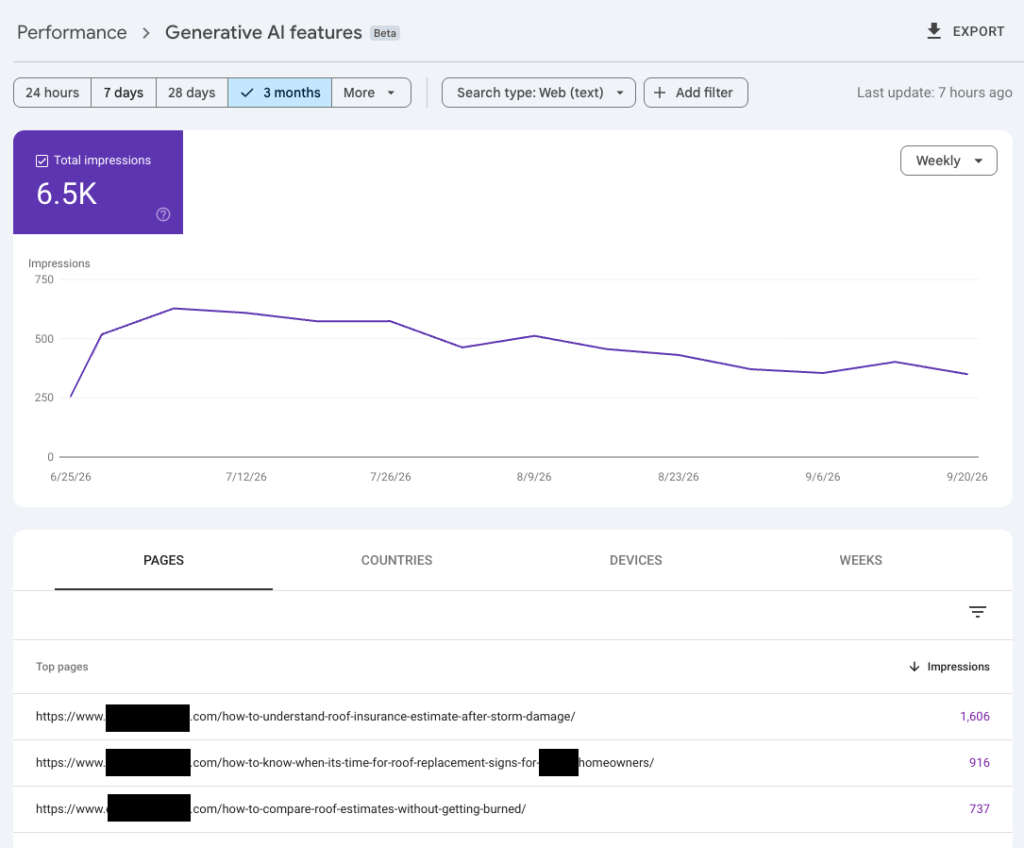
Google is providing more direct reporting around visibility generated through its AI-powered search experiences.
That matters because AI search reporting is still one of the least mature areas of digital marketing measurement.
A growing number of third-party platforms claim to measure:
- AI visibility
- Citations
- Brand mentions
- Prompt performance
- AI rankings
- Referral traffic
The reality is that none of these systems are perfect yet.
Why Roofers Should Care
You still need a benchmark.
Without one, it becomes difficult to determine whether changes to the website, content, local strategy, or authority are improving visibility inside AI-driven search.
AI visibility should not become another vanity metric.
The more useful question is:
Are the right pages being discovered for the services and markets that matter to the business?
How We Use AI Search Visibility Data
We treat AI visibility data similarly to the way we have traditionally evaluated traffic sources for individual pages.
For example, you might look at a page and ask how much traffic came from organic search, paid search, direct visits, email, or another source.
AI visibility becomes another useful layer.
What is particularly helpful is understanding which pages are being discovered through AI-related search activity.
That can help answer questions such as:
- Are people reaching the service page we expected them to?
- Is a blog article being surfaced instead?
- Is Google associating the wrong page with the subject?
- Are recent changes improving visibility?
- Are people finding the information we intended them to find?
It is not perfect keyword-level intelligence, but it provides a meaningful benchmark.
What Roofing Companies Should Do
Establish a baseline.
Identify:
- Pages receiving AI-related visibility
- Services represented by those pages
- Locations associated with those pages
- Pages gaining visibility
- Pages losing visibility
- Unexpected pages surfacing for important topics
Then compare that activity against actual business performance wherever possible.
AI visibility becomes useful when it helps determine whether the right information is reaching the right audience.
5. Homeowners Are Searching With Longer, More Specific Questions
What Changed
Search behavior is becoming more conversational.
People are increasingly comfortable typing or speaking complete questions rather than reducing everything to two or three words.
Instead of:
roofer near me
someone may search:
roofing contractor that installs CertainTeed shingles with a long workmanship warranty
or:
should I repair or replace my 20-year-old asphalt roof if it has several leaks
or:
best type of roof for a house near the coast
These longer searches give Google and AI systems significantly more information about what the person actually wants.
Why Root Keywords Still Matter
This does not mean foundational search terms no longer matter.
We still think in terms of what we call root words or core service concepts.
Examples include:
- Roofer
- Roofing company
- Roofing contractor
- Roof replacement
- Roof repair
- Metal roofing
- Commercial roofing
Those concepts remain important because longer conversational searches are often built around them.
What changes is the amount of context surrounding the core service.
A homeowner may also tell the search engine about:
- Material
- Location
- Problem
- Budget
- Warranty expectations
- Manufacturer preference
- Building type
- Urgency
- Stage of the buying process
That creates a much richer search.
What We’re Seeing
We agree with this shift because we are experiencing it in actual search behavior.
Traditional service terms still establish what the customer wants. Conversational searches add the details necessary to understand which version of that service is most relevant.
For roofing companies, this does not mean abandoning core service topics in favor of endless long questions.
The stronger approach is to clearly establish the service first, then answer the specific questions surrounding it. And don’t forget to link the Q&A articles back to the service page.
6. AI Search Is Breaking One Question Into Many Searches
What Changed
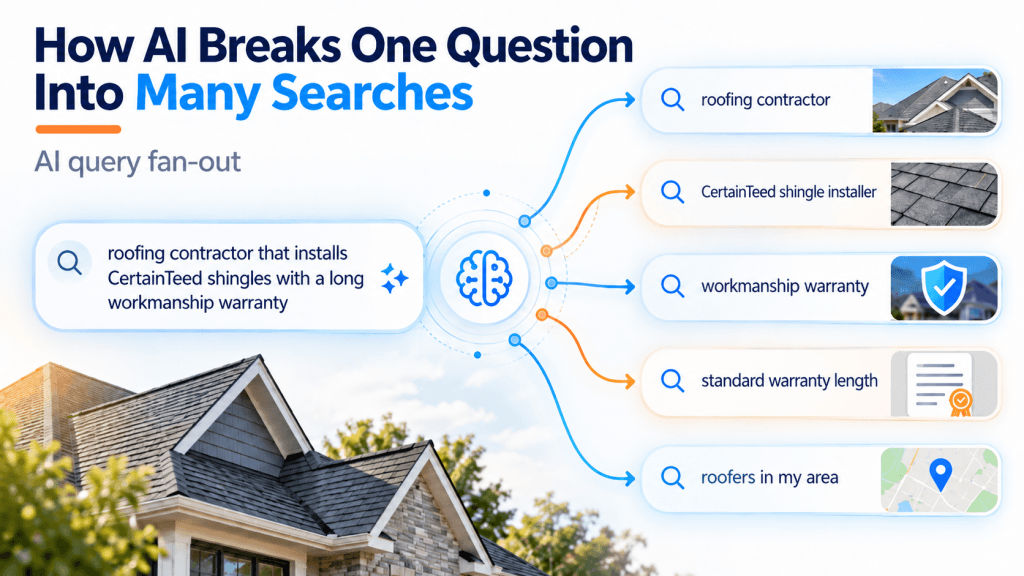
Google’s AI Mode can use a process known as query fan-out.
Instead of treating one long question as one traditional keyword, the system can break the request into multiple concepts, search for information around those concepts, and combine what it finds into a response.
This is one of the most important differences between traditional search behavior and increasingly conversational AI search.
How Query Fan-Out Could Work for a Roofing Search
Consider:
“Roofing contractor that installs CertainTeed shingles with a long workmanship warranty.”
An AI system can interpret that request as several information needs:
- Roofing contractor
- CertainTeed shingle installer
- Workmanship warranty
- Warranty length compared with typical roofing warranties
- Relevant contractors in the user’s location
It can then gather supporting information and organize the results according to relevance.
This is why simply placing one exact phrase repeatedly on a page is not enough.
What This Means for Roofing Content
Keep the root topic clear, then build strong supporting information around it.
For example:
Roof Replacement → Shingle Options → CertainTeed Credentials → Workmanship Warranty Information → Completed Replacement Projects → Customer Reviews → Service Area Relevance → Company Experience → Photos and Videos → FAQs
The stronger those relationships become, the easier it is for Google Search and AI systems to understand what the company actually does, where it operates, which materials and services it is experienced with, and what evidence supports those claims.
That is a much stronger strategy than trying to manufacture a separate page for every possible long-tail search.
7. Google Maps Is Becoming More of the Destination
What Changed
Homeowners can now learn far more about a roofing company without ever visiting its website.
Through Google Search, Maps, and the Google Business Profile, someone may be able to:
- Read reviews
- Call the company
- View business hours
- Browse project photos
- Watch videos
- See special offers
- Review services
- Ask questions
- Get directions
- Book appointments
- View business information
- Discover social content
- Compare nearby companies
Google has steadily reduced the number of reasons a customer needs to leave its ecosystem.
Our View
Google naturally benefits when users continue using Google products.
Search, Maps, YouTube, Local Services Ads, paid search, AI results, and Google Business Profiles all create opportunities for Google to help answer a customer’s questions before that customer ever reaches your website.
That does not make the roofing website less important. It changes its role.
The website helps Google and potential customers understand the company in greater depth. The Google Business Profile helps present the company during local discovery. Reviews establish social proof. YouTube and video can demonstrate expertise. Paid platforms capture existing demand. AI can organize information from several of these sources into an answer.
These assets should reinforce one another.
Why This Can Improve Lead Quality
Homeowners are also becoming more educated before they contact contractors.
A customer may already understand what type of roof they want, which materials they prefer, what warranties matter, which questions they should ask, whether the company works in their area, what previous customers say, and what the contractor specializes in.
By the time that customer contacts the company, they may be much further into the buying process.
That can help reduce some tire-kickers and early-stage shoppers.
What Roofing Companies Should Do
Treat your Google Business Profile as a complete business presentation.
Keep current:
- Photos
- Videos
- Reviews
- Services
- Categories
- Hours
- Offers
- Booking options
- Website information
- Business description
- Location information
- Staff and project imagery
The objective is not simply to rank in Google Maps.
It is to give the homeowner enough relevant information and confidence to take the next step.
8. Google Business Profiles Now Show “Collected Info”
What Changed
Google Business Profiles now provide owners with more visibility into information Google has collected about the business.
That matters because Google can encounter business information from multiple sources, including:
- Your website
- Your Google Business Profile
- Third-party websites
- Public sources
- Customers
- Direct interactions with the business
- Automated systems
Why This Matters
Citation management platforms such as BrightLocal and Yext have historically provided additional control over business information.
One benefit of these systems has been the ability to manage listings, reduce unwanted changes, and review updates before inaccurate information spreads.
Google is now providing businesses with more direct visibility into some of the information it has collected.
That is useful, but it also creates another reason to pay attention to consistency.
What We Expect as AI Expands
As AI plays a larger role in understanding businesses, we expect information reconciliation to become increasingly important.
If Google encounters conflicting information in different places, it has to determine which version is correct.
That can become particularly messy for multi-location roofing companies.
Imagine a roofing contractor with three offices where one page lists an old phone number, another lists a tracking number, an old directory contains a previous address, one location page lists services only offered by another office, hours differ across platforms, and service areas overlap incorrectly.
A person may be able to recognize what happened.
A machine must determine which information to trust.
What Roofing Companies Should Do
Keep your website and Google Business Profiles current.
If the company has multiple locations, clearly define each one.
Make it easy for customers, Google, and AI systems to understand:
- Where each office is located
- Which phone number belongs to it
- Which services it provides
- Which areas it serves
- Which hours apply
- Which staff members belong there
The clearer the underlying business information is, the less Google has to guess.
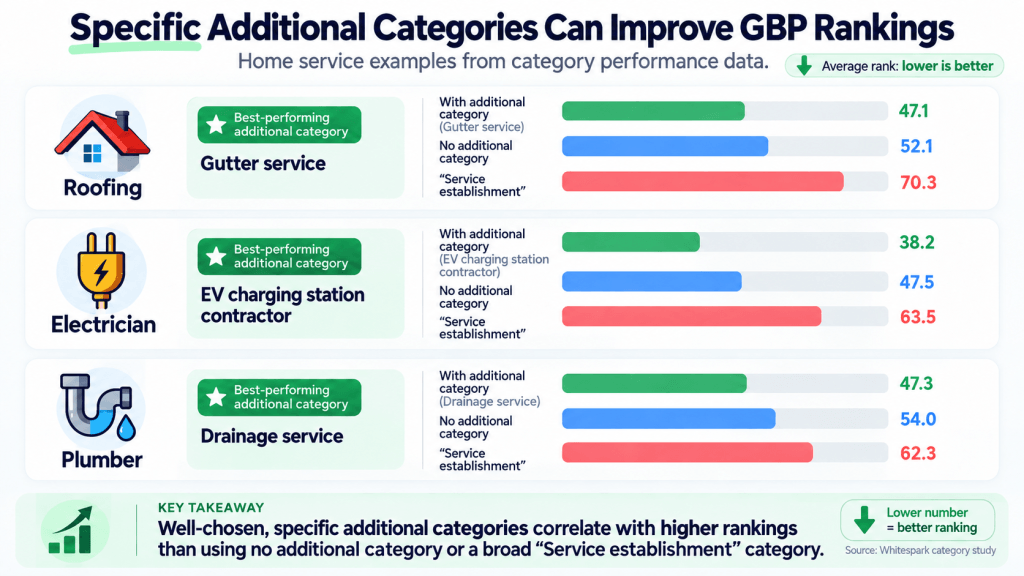
9. GBP Data Reinforces the Importance of Category Precision
What Changed
A Whitespark study analyzing approximately 1.8 million Google Business Profiles across thousands of categories reinforced something experienced local marketers have believed for years:
Category precision matters.
For contractors, a specific primary category such as Roofing Contractor generally performed better than a much broader category such as General Contractor.
Why This Makes Sense
A Roofing Contractor is relatively specific. That category can naturally encompass legitimate roofing services and materials such as asphalt shingles, tile roofing, metal roofing, roof repair, roof replacement, and roof inspections.
A General Contractor is much broader. That company may build a house, remodel a basement, replace doors, repair a garage, renovate a kitchen, perform exterior work, or coordinate multiple trades.
If someone specifically wants a roofing contractor, Google has less ambiguity when the company identifies itself as one.
What We’ve Seen
This is not a new strategy for us.
What is new is the scale of supporting data.
In a moderately competitive or highly competitive market, trying to rank prominently for roofing searches while using a broad primary category such as General Contractor creates an unnecessary relevance disadvantage.
That does not mean ranking is impossible. It means the business is asking Google to make a larger connection between what the person searched and what the business says it primarily does.
Overcoming that can require substantially more supporting authority, prominence, content, reviews, and other signals.
What About Additional GBP Categories?
Additional categories should not simply be variations of the same basic roofing concept.
They should help Google and potential customers understand other major services the company legitimately provides.
For example:
- Gutters
- Siding
- Windows
These are materially different services. They may be important parts of the business even if roofing remains the primary revenue driver.
The goal is not to fill every available category.
The goal is to accurately communicate what the company does.
10. Google’s August Spam Update Was More Disruptive Than Normal
What Changed
Google’s August 2026 spam update created substantial ranking volatility.
For roofing websites, that deserves attention because the industry has historically produced enormous amounts of repetitive content.
Examples include:
- Hundreds of location pages
- Nearly identical service-area pages
- Rewritten manufacturer information
- Thin roofing blogs
- AI-generated articles with little editorial review
- Multiple pages targeting essentially the same search intent
Our Approach Has Always Been Quality Over Quantity
Our focus has consistently been:
Every page needs a reason to exist.
We currently see approximately a 99% success rate getting the webpages and articles we produce indexed, and one reason is that we try to give every piece of content a distinct purpose.
Each page or article should have a unique focus, a clear audience, a clear intent, and enough useful information to justify its existence.
A page may naturally rank for many different searches. That is normal.
Creating separate pages merely because several slightly different keyword phrases exist is a different strategy entirely.
Different Roofing Services Can Have Different Search Intent
Different roofing services can justify separate pages when the customer intent, materials, questions, and decision-making process are meaningfully different.
For example, Metal Roofing Services and Tile Roofing Services can each support their own page. The materials are different, installation methods vary, pricing and ideal applications may differ, and homeowners typically have different questions when comparing those roofing systems.
Each page can therefore provide distinct value rather than repeating the same information with different terminology.
The same logic does not necessarily apply to Tile Roofing Installation, Tile Roof Replacement, and Tile Reroof.
In many cases, those phrases represent substantially the same commercial intent: a property owner looking for a contractor to install or replace a tile roof.
Creating three separate pages simply because three keyword variations exist can result in overlapping content, unnecessary duplication, and multiple pages competing to answer essentially the same customer need.
A better approach is to create one comprehensive page that addresses the complete commercial intent while naturally covering the different terminology customers may use.
The deciding factor should not be whether another keyword exists.
It should be whether the searcher is looking for meaningfully different information.
When Similar Roofing Topics Can Become Different
Similar terminology can still justify separate content when the underlying intent changes.
For example, Tile Roof Replacement Services is a commercial service query.
Tile Roofing Installation DIY Tips is informational and directed toward someone trying to understand or perform the process.
Should I Choose Tile or Metal for My Reroof? is a comparison question from someone deciding between materials.
These represent different topics, audiences, and stages of the customer journey. They can justify different content because they are solving different problems.
Roofing Area Pages Need the Same Standard
A local roofing page should not simply be the same page with the city name replaced.
For example, Roofing Contractor in Sugar Grove, Illinois and Roofing Contractor in Chicago, Illinois should contain meaningful differences if the company legitimately serves both markets.
Even the photos should ideally differ because part of the page’s job is proving that the roofing company genuinely works in that area.
Useful supporting evidence can include:
- Projects completed in the city
- Original project photos
- Customer reviews from that area
- Local roofing considerations
- Common roofing materials
- Local pricing differences
- Building styles
- Weather considerations
- Permit information where relevant
- Neighborhood or property differences
If the company has a legitimate physical office in each city, location-specific information may also include the address, local phone number, staff, hours, and location-specific reviews.
These details matter to potential customers.
They also create stronger evidence for search engines and AI systems trying to determine whether the company genuinely operates in that location.
What the Spam Update Should Reinforce
The objective should not be:
How many pages can we get Google to index?
It should be:
How many genuinely useful resources can we create for the people, services, and markets we actually want to serve?
That is a more sustainable strategy for traditional search and AI-driven search alike.
What Hasn’t Changed About SEO for Roofing Companies
AI search has changed how information can be discovered and presented.
It has not eliminated the fundamentals of good SEO.
Roofing companies still need:
- A technically accessible website
- Pages Google can crawl and index
- Clear service information
- Strong local relevance
- Useful content
- Accurate business information
- Reviews
- Authority
- Original photos and project evidence
- Logical internal relationships between pages
- Strong conversion paths
AI does not eliminate SEO.
It expands the number of ways that strong SEO, local relevance, business information, and original expertise can be discovered and used.
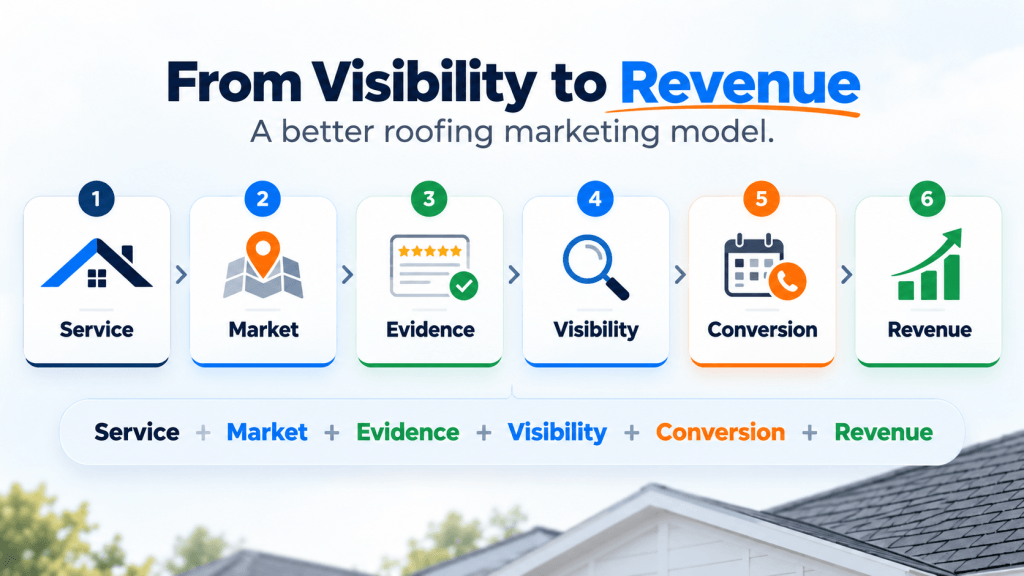
The Most Important Strategy Change We Recommend
The traditional roofing SEO model often looked something like:
Keyword → Page → Ranking → Traffic
That model is now incomplete.
A stronger model is:
Service + Market + Evidence + Visibility + Conversion + Revenue
For every important roofing service and market, Google, AI systems, and potential customers should be able to determine whether the company actually provides that service in that location, whether it has evidence of relevant experience, whether customers confirm that experience, and whether the homeowner can easily take the next step.
That means the website, Google Business Profile, reviews, completed projects, original photos, credentials, citations, advertising, sales process, and follow-up systems need to reinforce the same story.
30-Day Google Search & AI Action Plan for Roofing Companies
Not every Google change requires a major reaction.
Some require immediate action. Others require preparation or monitoring.
| Priority | Action | Why It Matters |
|---|---|---|
| DO NOW | Export historical LSA data | You need a reliable baseline before the campaign environment changes. |
| DO NOW | Audit missed-call rate | Missed calls can create significant booking losses and may now affect LSA cost. |
| DO NOW | Improve call coverage | Receptionists, call centers, or AI can help prevent qualified opportunities from being lost. |
| DO NOW | Book qualified leads during initial contact | Callbacks introduce unnecessary attrition. |
| DO NOW | Review GBP Collected Info | Incorrect information should be identified and corrected quickly. |
| DO NOW | Establish an AI visibility baseline | Future improvement is difficult to evaluate without a starting point. |
| DO NOW | Audit GBP categories | The primary category should accurately describe the company’s main business. |
| PREPARE | Review booking integrations | Direct scheduling can reduce friction between lead and appointment. |
| PREPARE | Identify top service-market combinations | These areas deserve the strongest proof, content, reviews, and conversion support. |
| PREPARE | Mine customer questions | Longer searches reveal real concerns and buying intent. |
| MONITOR | Compare LSAs before and after migration | Judge performance by qualified opportunities and sold work, not raw leads alone. |
| MONITOR | Track AI visibility against business outcomes | More AI visibility matters most when it reaches the right audience. |
| MONITOR | Watch Maps interactions alongside rankings | Stable rankings can still produce different customer behavior. |
| MONITOR | Review ranking changes after spam updates | Diagnose affected content before making widespread changes. |
How to Apply the 30-Day Plan to Your Roofing Company
Start with the company’s three highest-value services and three most important markets.
That creates nine priority service-and-market combinations.
For each one, audit:
- Search visibility
- AI visibility
- Main service page
- Local relevance
- Google Business Profile
- Reviews
- Completed project evidence
- Original photos and video
- Independent authority
- Conversion path
- Call handling
- Appointment booking
- Follow-up
- Qualified opportunities
- Estimates
- Sold jobs
- Revenue
Then identify the weakest point in the chain.
A roofing company may already rank well but have weak reviews. Another may have excellent reviews but weak service pages. Another may generate plenty of calls but miss 30% of them. Another may answer every call but fail to book the appointment. Another may produce plenty of estimates but have weak sales follow-up.
The objective is not simply more traffic.
It is more of the right people finding you, trusting you, contacting you, booking with you, and becoming profitable customers.
What Should Roofing Companies Measure Now?
Rankings, impressions, traffic, and clicks still matter.
But none of them should be the final measurement.
| Stage | Useful Measurements | Business Question |
|---|---|---|
| Visibility | Organic rankings, Maps rankings, AI visibility, LSA visibility | Are the right homeowners finding the company? |
| Engagement | Website visits, GBP interactions, calls, forms, texts, bookings | Are they taking the next step? |
| Lead Quality | Qualified calls, qualified forms, correct service, correct location | Are these opportunities the company actually wants? |
| Booking | Appointment rate, missed calls, callback rate, booking rate | Are interested homeowners making it onto the calendar? |
| Sales Activity | Inspections, estimates, follow-up | Is the sales team moving opportunities forward? |
| Sales Results | Sold jobs, close rate, average job value | Is marketing creating actual business? |
| Financial Results | Cost per sold job, attributed revenue, marketing ROI | Is the business making enough money from the investment? |
A roofing company can increase traffic while generating worse leads. It can generate more leads while booking fewer appointments. It can receive fewer website visits while producing more qualified calls.
And it can rank extremely well while still losing revenue because nobody answers the phone.
That is why marketing performance should be evaluated across the entire customer journey.
Frequently Asked Questions About Google AI Search Changes for Roofers
What Google AI search changes matter most for roofing companies right now?
The most important changes involve Local Services Ads, missed-call billing, direct appointment booking, AI visibility reporting, longer conversational searches, AI query fan-out, Google Maps behavior, Google Business Profile information, category precision, and Google’s continued effort to reduce low-value or repetitive content. The impact of each change depends on how the roofing company currently generates, handles, and converts leads.
Are Google Local Services Ads going away for roofing companies?
No. Google is changing how certain Local Services Ads campaigns are managed, but the pay-per-lead model is not going away. Roofing companies should preserve historical performance data and monitor qualified lead volume, booking rates, sold jobs, and acquisition costs before and after migration so they can determine whether the new campaign structure is actually improving performance.
Is traditional SEO becoming less important because of AI search?
No. Traditional SEO still matters because search engines and AI systems need to understand what a company does, where it operates, what information it provides, and whether that information is trustworthy. What is changing is how that information is found, assembled, and presented. Strong SEO now supports both traditional search visibility and AI-driven discovery.
Do roofing companies need a separate AI SEO strategy?
Not necessarily. Strong technical SEO, useful content, local relevance, original expertise, accurate business information, project evidence, reviews, images, video, and clear service relationships can benefit both traditional Google Search and AI-powered search experiences. AI should expand the strategy, not replace the fundamentals that already help search engines understand and trust a roofing company.
Should roofing companies create more pages to appear in AI search results?
Not simply for the sake of creating more pages. Each page should have a distinct purpose and search intent. Multiple near-identical pages targeting slightly different wording can create unnecessary duplication. A smaller number of useful, specific, well-supported pages is generally more valuable than publishing large amounts of repetitive content with little original value.
How quickly should a roofing company answer new leads?
As quickly as possible, and ideally within about 20 seconds when practical. In our 2026 observations, missed calls created significant booking losses, while all eight roofing teams that adopted AI answering or call-center coverage subsequently saw an increase in appointment bookings. Faster response improves the chance of connecting with the homeowner before they move on to another contractor.
Isn’t calling a missed lead back enough?
Usually not. The roofing sales teams we spoke with generally reported reconnecting with only about 40% to 50% of missed callers. By the time they reestablished contact, many homeowners had already moved on. In the situations we reviewed, roughly one out of every 10 missed calls ultimately resulted in a booked callback, showing how much opportunity can disappear after the initial call.
Should roofing companies send qualified leads a booking link?
A booking link is better than providing no next step, but whenever possible, book the appointment for the homeowner during the initial call or text conversation. Every additional action creates another chance for the lead to disappear. If someone is qualified and ready to schedule, getting the appointment on the calendar immediately is usually the stronger conversion strategy.
Why does Google Business Profile matter if the company already has a strong website?
Because homeowners can now complete much more of their research directly inside Google. They can read reviews, view photos, watch videos, see hours, review services, call, get directions, and sometimes book an appointment without visiting the website. The website is still important, but it now works alongside the Google Business Profile as part of a larger search and conversion ecosystem.
Should roofing companies change their entire keyword strategy because searches are becoming longer?
No. Core service concepts such as roofer, roofing contractor, roofing company, roof replacement, and roof repair still matter. The change is that homeowners are adding more context around those concepts, including materials, warranties, locations, problems, timing, and specific requirements. The better strategy is to keep the core service clear while answering more detailed questions around it.
Should every roofing service have its own page?
Only when the search intent is meaningfully different. Metal roofing and tile roofing can justify separate pages because the materials, questions, costs, and installation considerations are different. Tile roof replacement, tile roof installation, and tile reroof may often represent the same commercial intent and may be better handled on one comprehensive page rather than split into overlapping content.
What is the most important action roofing companies should take from these changes?
Look at the complete path from visibility to revenue. Identify the services and markets that produce the most valuable work, then evaluate visibility, trust, contact, booking, estimates, sales, and revenue. Improving the weakest point in that chain can produce more business value than focusing only on rankings, traffic, or lead volume.
One Additional Google Business Profile Update
Google has also restored post-level view counts inside Business Profiles.
This gives roofing companies another way to compare which types of GBP content receive attention, including completed projects, educational posts, roofing materials, service information, storm-related information, offers, and company updates.
The data can be useful, but views remain a supporting metric.
A roofing company cannot deposit impressions into its bank account.
The final measurement should still be:
Qualified opportunities, appointments, sold jobs, and revenue.
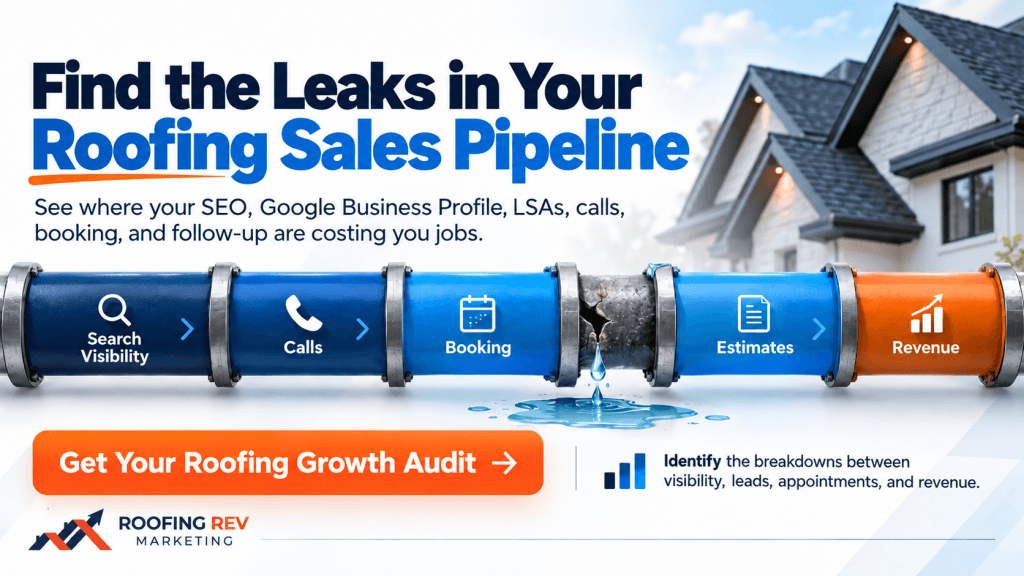
Turn Google Search Changes Into More Roofing Opportunities
Most of the changes covered in this report have one thing in common:
They reward roofing companies that remove friction between being found and getting the appointment.
That means answering faster, responding consistently, booking immediately, keeping business information accurate, properly managing Local Services Ads, and preventing opportunities from disappearing because someone was unavailable.
These are not theoretical problems for us.
They are problems we already help roofing and exterior companies solve.
Roofing REV Marketing can help implement systems such as:
- AI voice agents that answer calls when your team cannot, including after hours
- 24/7 call coverage so qualified opportunities are not automatically lost when the office closes
- Live call transfers that allow AI to identify and route qualified callers to the appropriate person
- AI conversation agents that respond to and continue text-message conversations
- Automated appointment booking connected to your company’s actual calendar availability
- Custom booking criteria so appointments are scheduled according to your services, markets, availability, and qualification requirements
- Direct Local Services Ads booking integrations that reduce unnecessary steps between the lead and the appointment
- LSA response automation that helps leads receive timely responses
- Lead categorization and rating processes that keep Local Services Ads accounts properly managed
- Systems for identifying and disputing potentially invalid LSA leads when appropriate
- Human and AI scheduling from the same booking system, so your team is not working from disconnected calendars or processes
The goal is not automation for the sake of automation.
It is to eliminate preventable revenue leaks.
A roofing company should not spend money generating a qualified lead only to lose that person because nobody answered the phone. It should not qualify a homeowner and then ask them to wait for someone else to call back and schedule. And it should not invest in Google Search, AI visibility, Local Services Ads, SEO, or advertising without a reliable system for turning that visibility into appointments and sales.
The technology now exists to close many of those gaps.
If your roofing or exterior company is generating opportunities but losing them somewhere between the first search, first call, appointment, estimate, and sale, Roofing REV can help identify where that breakdown is occurring and build the systems needed to improve it.
The objective is not more marketing activity. It is more qualified opportunities becoming booked appointments, sold jobs, and revenue.
About the Author
Chris Taglia is COO of Roofing REV Marketing, where he works directly with roofing and exterior companies on SEO, Google Business Profiles, Local Services Ads, paid search, CRM automation, AI lead handling, and sales conversion systems. His recommendations are informed by active client campaigns, CRM data, sales-team meetings, and first-hand observations of how changes across Google Search, AI, Maps, and LSAs affect lead quality, appointment bookings, and revenue.


LSA Budget for Roofers: Set It Right & Get More Leads
Your LSA budget doesn’t control how much you spend—it controls whether you get leads at all. For roofers using Google Local Service Ads, this is one of the most misunderstood parts of the platform. This guide is for roofing business owners and marketing managers who...
Google Local Service Ads vs Google Ads for Roofers
Google Local Service Ads vs Google Ads for roofers is one of the most important decisions when you want more roofing leads from Google. Most roofing companies think it comes down to one thing: pay per lead vs pay per click. That matters, but it is not the full answer....

How Roofers Should Dispute Bad Google Local Service Ad Leads
Dispute google local service ad leads is one of the most overlooked ways for roofers to control cost and improve profitability from LSAs. Most roofing companies focus on getting more leads. That’s only half the equation. If you’re paying for the wrong leads,...