

Your LSA budget doesn’t control how much you spend—it controls whether you get leads at all. For roofers using Google Local Service Ads, this is one of the most misunderstood parts of the platform.
This guide is for roofing business owners and marketing managers who want to generate more Local Service Ads leads without artificially limiting their ability to receive them.
What Is the Best LSA Budget for Roofers?
The best LSA budget for roofers is a high weekly budget ceiling, typically $500 to $1,000 or more, designed to avoid missing leads rather than control spend. Google Local Service Ads do not guarantee spend, so most roofing companies will not use their full budget due to limited market demand and competition.
How LSA Budgets Actually Work for Roofers
LSA budgets work as weekly spending ceilings, not fixed costs. Increasing your budget does not create more roofing leads—it only increases your eligibility to receive them. Because Local Service Ad lead volume is limited, the goal is to capture as many available leads as possible, not scale spend.
About the Author
This guide is based on real-world experience managing Google Local Service Ads for roofing companies.
Chris Taglia, COO of Roofing REV Marketing, has been in marketing since 2008, with over 15 years in contractor marketing and a specialized focus on roofing since 2024.
He has helped market over 250 businesses and contributed to generating more than $220 million in revenue across service industries.
Table of Contents
- How LSA Budgeting Actually Works
- Why LSA Budgeting Is Different From Google Ads
- Why Most Roofers Misunderstand LSA Budgets
- The Real Constraint: There Are Only So Many LSA Leads
- Automatic vs Manual Bidding
- What Real Roofing LSA Spend Looks Like
- When to Use Automatic vs Manual Bidding
- Why Setting a Higher Budget Works
- How to Think About Cost Per Lead and ROI
- Retail Roofing vs Storm Roofing Economics
- The Most Common LSA Budget Mistake Roofers Make
- How to Maximize Every Available Lead
- When to Raise, Lower, or Pause Your Budget
- Why LSAs Should Be Maximized, Not Relied On Alone
- What This Does Not Mean
- Key Takeaways
- FAQs
How LSA Budgeting Actually Works
Google Local Service Ads operate on an average weekly budget, not daily or fixed monthly budgets.
This weekly number acts as a ceiling. It defines how much you are willing to spend if qualified leads are available, but it does not guarantee that Google will spend that amount.
Actual spend is determined by demand, competition, responsiveness, and account performance.
That is why Google Local Service Ads management for roofing companies matters after setup, not just during launch.
Why LSA Budgeting Is Different From Google Ads
Google Ads and Local Service Ads operate on completely different models.
- Google Ads: More budget typically means more clicks, more traffic, and more spend.
- LSAs: Budget does not create more leads—it only affects whether you receive them.
LSAs are not a scaling channel. They are a competitive allocation system, where Google distributes a limited number of leads across contractors.
Why Most Roofers Misunderstand LSA Budgets
A common question is: How much should roofers spend on LSAs?
The better question is: How should you set your LSA budget so you don’t miss leads?
That shift matters because LSAs do not work like traditional ads.
They are not designed to scale infinitely. They distribute a fixed number of leads based on demand and performance.
Increasing your LSA budget does not create more leads. It simply ensures you are eligible to receive the leads that already exist.
The Most Common LSA Budget Mistake Roofers Make
Most roofing companies set their LSA budget based on how much they want to spend, not how the platform actually works.
This leads to budgets that are too low, which limits visibility and reduces the number of leads they are eligible to receive.
LSA budgets should be set high enough to avoid restrictions, not to control spend.
This is one of the issues seen in common LSA mistakes that hurt roofing performance.
The Real Constraint: There Are Only So Many LSA Leads
There is a fixed number of LSA leads in every roofing market. That number is influenced by demand, seasonality, and competition.
Most roofing companies will not spend their full LSA budget in many months throughout the year. This is normal and reflects limited demand—not poor setup.
That means LSAs are not a scaling channel—they are a competitive allocation system.
Google is not generating more roofing leads for you. It is deciding which contractors receive the leads that already exist.
Once you understand that, budgeting becomes a strategy of maximizing access, not controlling spend.
But if lead flow drops, it helps to understand why roofing Local Service Ads stopped working before making reactive budget changes.
Automatic vs Manual Bidding
Automatic bidding
Google controls cost per lead and maximizes lead volume within your weekly budget. This is the default and works well for most roofing companies.
Manual bidding
You set both your weekly budget and your max cost per lead. In roofing, max bids can go very high, but actual leads typically cost far less.
Best practice: Set a high max cost per lead to avoid limiting performance.
What Real Roofing LSA Spend Looks Like
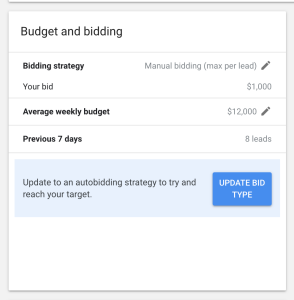 | 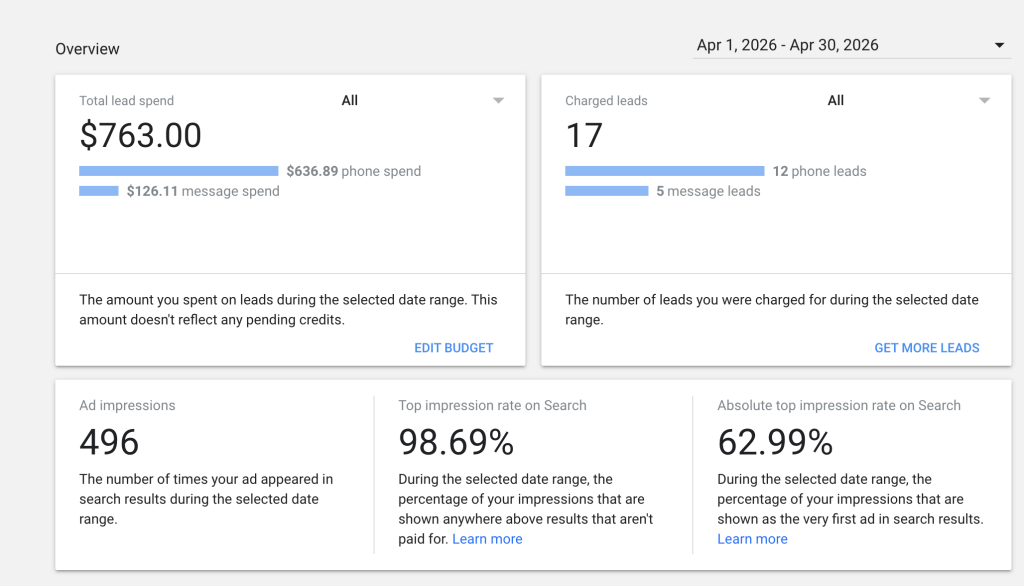 |
Manual Bidding Real-World Example
- Weekly budget: $12,000
- Max lead bid: $1,000
- Actual spend: $763
- Total leads: 17
- Cost per lead: $44.88
Automatic Bidding Real-World Example
- Weekly budget: $1,000
- Max lead bid: maximize leads
- Actual spend: $701
- Total leads: 12
- Cost per lead: $58.42
How These Benchmarks Were Derived
The data and examples on this page are based on internal client account data from Google Local Service Ads dashboards, including reporting, profile settings, and bidding configurations.
These insights reflect approximately 10 roofing accounts (20+ across home services), focused on residential roofing services such as roof repair, roof replacement, and storm damage.
The real-world example shown is based on a recent 30-day period during busy season (March–April 2026). Cost per lead and cost per customer ranges reflect observed historical performance and align with broader roofing industry benchmarks.
While results vary by market and competition, the patterns shown here are consistent across accounts.
When to Use Automatic or Manual Bidding
Start with Automatic Bidding if:
- You are launching or recently started your LSA account
- You want Google to build trust and optimize performance over time
- You have limited time to manage bidding manually
Starting with manual bidding too early can confuse Google’s system and limit performance before your account has enough data.
Use Manual Bidding when:
- Your account is established and consistently generating leads
- You want more control over cost per lead
- You are actively monitoring performance and lead quality
Manual bidding works best after Google has enough data to understand your account performance.
Why Setting a Higher Budget Works
A higher LSA budget does not increase spend—it removes restrictions.
If your budget is too low, you may miss leads during peak demand. If your budget is high enough, you remain eligible for all available opportunities.
Budget works best when paired with strong operations, including the daily LSA routine roofers should follow.
 |
– Chris Taglia, COO of Roofing REV Marketing |
How to Think About Cost Per Lead and ROI
Retail roofing LSA benchmarks:
- $50–$125 cost per lead
- $125–$300 cost per customer
With an average job value of $20,000:
- $125 acquisition cost = 0.625% of revenue
- $300 acquisition cost = 1.5% of revenue
This is why many roofing companies underinvest in LSAs. They focus on cost per lead instead of cost relative to revenue.
When evaluated correctly, LSAs are often one of the lowest-risk, highest-return channels available.
For broader channel comparison, see real roofing lead cost by channel.
Retail Roofing vs Storm Roofing Economics
Retail roofing
- $50–$125 per lead
- $125–$300 per customer
- Consistent demand
Storm roofing
- $150–$200 per lead
- Higher job values
- Event-driven demand
Storm-related roofing leads are often higher due to competition and urgency. Some industry data sources report ranges around $150–$200 per lead in competitive markets, particularly for insurance-driven work.
How to Maximize Every Available Lead
- Answer calls immediately
- Respond to messages quickly
- Manage and update every lead
- Maintain consistent reviews
- Stay active in your account
These factors are strengthened by improving call answer speed, building review momentum, and knowing how to dispute bad LSA leads.
Because you cannot create more LSA leads, your advantage comes from how you compete for them.
When to Raise, Lower, or Pause Your Budget
Increase budget when:
- Leads stop early in the week
- Demand increases
- You have capacity
Decrease or pause when:
- Calls are being missed
- Schedule is full
- Lead handling declines
Why LSAs Should Be Maximized, Not Relied On Alone
LSAs are a high-intent channel but limited in volume. They should be maximized but combined with other channels like Google Ads, branding, and referrals for growth.
If you are deciding where LSAs fit in the channel mix, compare Google Local Service Ads vs Google Ads for roofers.
What This Does Not Mean
- Setting a higher budget does not guarantee more leads
- Manual bidding is not always better for every account
- Low spend does not automatically mean poor performance
LSAs are controlled by demand and competition, not just budget settings.
Key Takeaways
LSA budgeting is not about how much you spend.
It is about whether you are positioned to receive leads when they become available.
- Budgets are weekly ceilings, not spending targets
- Lead volume is limited by market demand
- Increasing budget improves access—not volume
- Most roofing companies will not spend their full budget
- Performance determines who gets the leads
The goal is simple: Capture as many of the available leads as possible.
Most roofing companies try to control LSA spend, but the best-performing companies remove restrictions instead.
They set their budgets high enough to stay competitive, respond faster than anyone else, and focus on capturing every available opportunity.
Because in LSAs, you are not competing on budget. You are competing on who is positioned to win the lead when it happens.
Ready to build a stronger LSA system?
If you want to consistently capture more of the limited LSA leads in your market, you need a system—not just a budget.
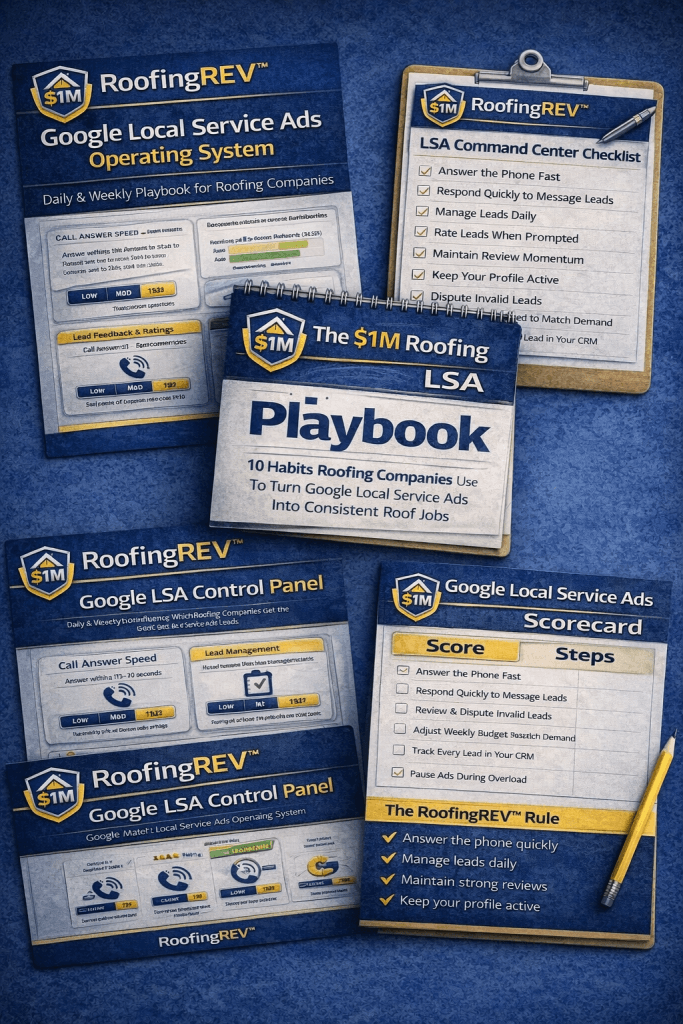
In simple terms: LSA budgeting is about access, not forced spend. Roofing companies that set high enough budgets, respond quickly, and manage leads effectively are in the best position to capture the limited demand available in their market.
FAQs
How much should roofers spend on Google Local Service Ads?
Roofers should set a weekly LSA budget high enough to avoid missing leads, typically $500 to $1,000 or more per week. This budget acts as a ceiling, not a target, so actual spend is often much lower because lead volume is limited by market demand and competition.
Why isn’t my LSA budget being fully spent?
Your LSA budget is not being fully spent because there are not enough leads available in your market. Google only charges for leads when demand exists and distributes them across competing contractors, so unused budget usually reflects limited demand—not a setup issue.
Do higher LSA budgets increase spend?
No, higher LSA budgets do not guarantee higher spend. Increasing your budget simply allows you to stay eligible for more leads when they become available, but actual spend is still controlled by market demand, competition, and Google’s lead distribution system.
Should roofers use automatic or manual bidding?
Most roofers should start with automatic bidding because Google optimizes for lead volume within your weekly budget. Manual bidding can work well if you want more control, but it requires setting a high max cost per lead to avoid restricting your ability to receive leads.
What should be set as a max cost per lead in manual bidding?
Roofers should set a high max cost per lead in manual bidding, often several hundred dollars or more. Even though Google may allow bids up to around $1,000, actual roofing LSA leads typically cost far less, so a higher cap prevents limiting performance.
What is a good cost per lead for retail roofing LSAs?
A good cost per lead for retail roofing LSAs typically falls between $50 and $125. This range depends on your market, competition, and service area, but it is common for retail-focused roofing companies to see consistent lead volume within this cost range.
What is a good cost per customer for roofing LSAs?
Most roofing companies see a cost per acquired customer between $125 and $300 through LSAs. With average roof replacement values around $20,000, this makes LSAs one of the most cost-effective and highest-return marketing channels available.
Can LSAs scale a roofing company on their own?
No, LSAs cannot scale a roofing company on their own because they are limited by market demand. They are a high-intent lead source, but to grow consistently, roofers need to combine LSAs with other channels like Google Ads, referrals, and local branding.
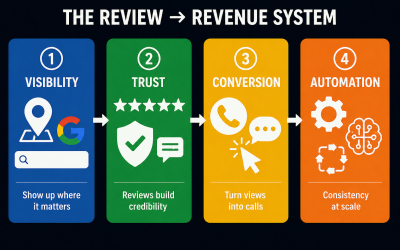
How AI Turns Roofing Reviews Into More Jobs
How AI actually turns reviews into roofing jobs is now one of the most important drivers of visibility, trust, and revenue for roofing companies competing in Google Maps, Local Service Ads, and AI search results. This guide is for roofing business owners and marketing...

Google Local Service Ads vs Google Ads for Roofers
Google Local Service Ads vs Google Ads for roofers is one of the most important decisions when you want more roofing leads from Google. Most roofing companies think it comes down to one thing: pay per lead vs pay per click. That matters, but it is not the full answer....
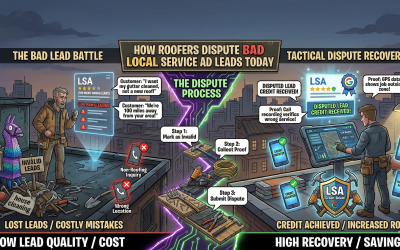
How Roofers Should Dispute Bad Google Local Service Ad Leads
Dispute google local service ad leads is one of the most overlooked ways for roofers to control cost and improve profitability from LSAs. Most roofing companies focus on getting more leads. That’s only half the equation. If you’re paying for the wrong leads,...