
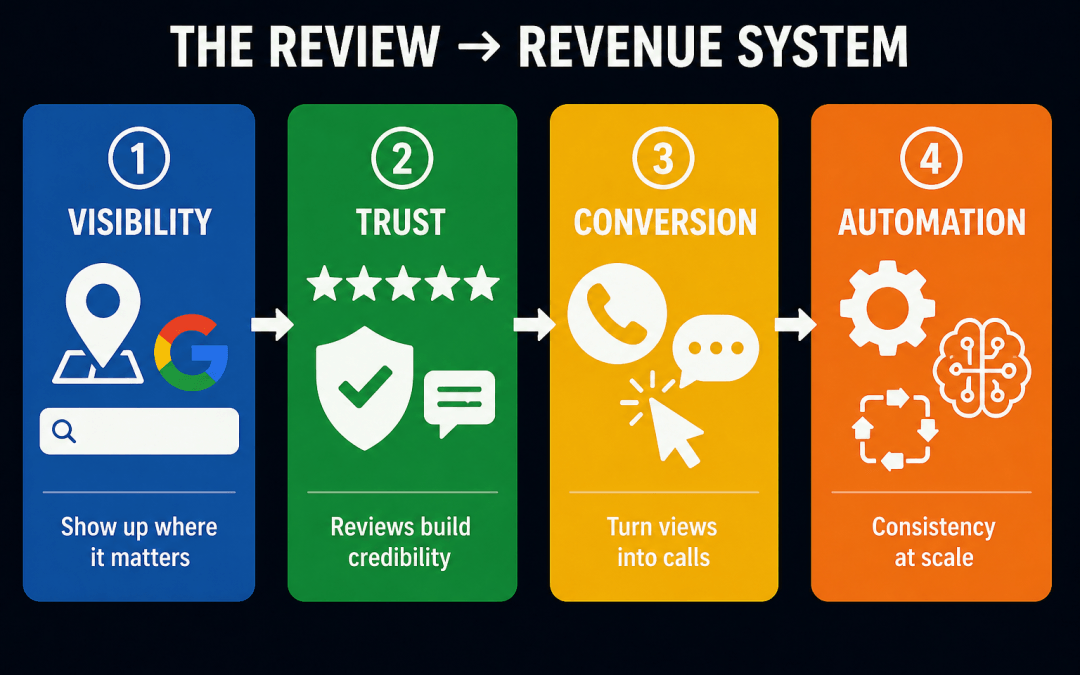
How AI actually turns reviews into roofing jobs is now one of the most important drivers of visibility, trust, and revenue for roofing companies competing in Google Maps, Local Service Ads, and AI search results.
This guide is for roofing business owners and marketing managers who want to generate more qualified leads, improve ranking positions, and build a system that consistently turns completed jobs into new opportunities.
Reviews are no longer just reputation—they are structured data that AI systems use to determine which roofing companies get visibility, trust, and calls. Companies that control review consistency, quality, and content outperform competitors in Google Maps and Local Service Ads. When implemented correctly, reviews become scalable referrals that drive predictable revenue growth.
What Is the Fastest Way to Turn Roofing Reviews Into Jobs?
The fastest way to turn roofing reviews into jobs is to implement a structured system that consistently generates high-quality, service-specific reviews, distributes them across your marketing assets, and aligns them with how AI evaluates local businesses. This increases visibility, builds immediate trust, and improves conversion from search to call.
AI Overview: How Reviews Drive Roofing Revenue
AI-powered review systems are structured processes that convert customer feedback into visibility, trust, and conversion signals. AI evaluates patterns in review frequency, content, and engagement to determine which roofing companies appear in Google Maps, Local Service Ads, and AI-generated search results. For a deeper look at how AI affects search visibility, see this guide on AI SEO for roofers.
How Roofing Decisions Are Made Today
Roofing decisions now happen across Google Maps, Local Service Ads, and AI-generated summaries—not just referrals. AI is already influencing who gets selected before a call is made.
That shift is especially important because how property owners choose roofing companies is changing across AI, Google, and voice search.
AI visibility is the likelihood of being selected within algorithm-generated search results. If your company is not consistently producing review signals, it is effectively invisible during the decision window.
Reviews influence who gets seen before they influence who gets chosen. That means reviews are no longer feedback alone. They are ranking signals, trust signals, and conversion signals.
Residential vs Commercial Buyers
Roofing buyers evaluate reviews differently depending on what is at risk.
Homeowners are driven by trust and comfort. They want to know whether a roofing company communicates well, protects their property, cleans up properly, and does what it promised. For residential buyers, reviews act like scalable referrals.
Commercial buyers—property managers, HOAs, facility managers, and building owners—evaluate reviews through risk. They want proof that the contractor can handle project scope, timelines, coordination, and disruption control.
A residential review builds comfort. A commercial review reduces risk.
Review relevance is how closely a review matches a specific service, project type, or buyer intent. If your reviews lack commercial language, your company is less likely to be understood for commercial-intent searches.
Why Most Roofers Lose Jobs Even With Good Reviews
Most roofing companies do not lose because they lack reviews. They lose because their reviews lack structure.
They ask inconsistently, receive generic responses, fail to guide customer feedback, and rarely connect reviews to search, sales, and conversion. This creates random signals.
AI does not reward randomness—it rewards patterns.
Review velocity is the rate at which new reviews are generated over time. Without consistent review velocity, visibility fluctuates and rankings become unstable.
The companies that win in roofing are not always the ones with the most reviews. They are the ones with the most consistent signals.
The Review-to-Revenue System™
The Review-to-Revenue System™ converts completed jobs into future opportunities through four connected functions: visibility, trust, conversion, and automation.
Visibility
Visibility is the ability to appear at the exact moment a buyer searches. Reviews influence this through frequency, recency, and relevance. A steady flow of reviews signals an active, trusted, and relevant roofing company.
In roofing, visibility is created through consistency, not volume. Review gaps create revenue gaps because they weaken the signals that help roofing companies appear in Maps, LSAs, and AI-driven search results. If Maps visibility is a priority, this Google Maps for roofers blueprint explains the larger ranking system.
Trust Signals
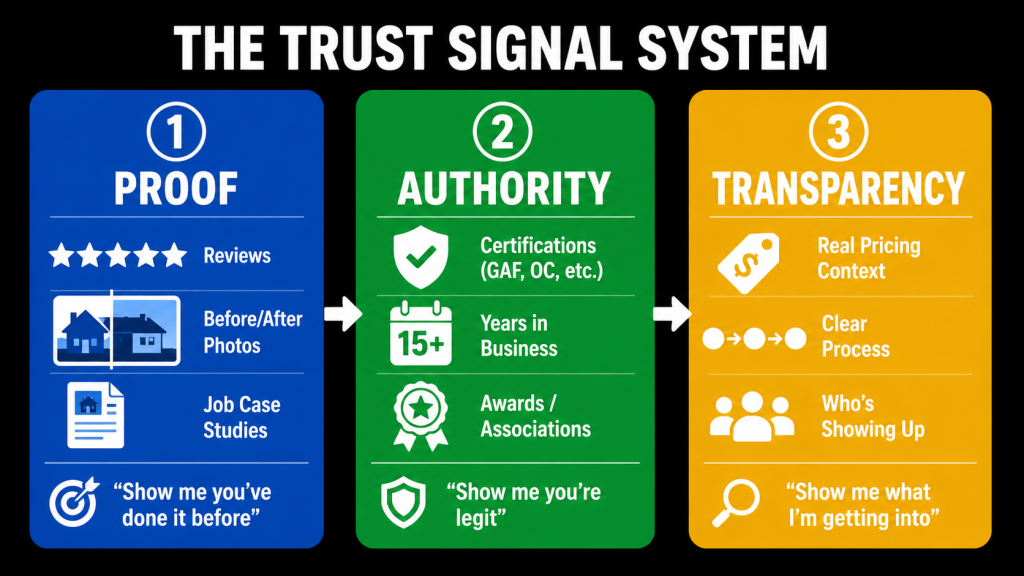
Trust signals reduce uncertainty for the buyer. For homeowners, trust is built through communication, cleanliness, professionalism, and reassurance. For commercial buyers, trust is built through proof of project execution.
A generic review that says “great job” has limited value. A detailed review that mentions a roof replacement, insurance process, timeline, cleanup, TPO roof, flat roof, HOA property, or commercial building gives both buyers and AI systems more useful information.
A review without context has limited impact on conversion.
Conversion
Conversion happens when review language matches the website, sales process, and buyer expectations.
Conversion alignment is when review language matches on-page messaging and sales conversations. If reviews repeatedly mention fast cleanup, clear communication, insurance help, or minimal business disruption, those same themes should appear on the website and in sales materials. This is why roofing website conversion matters: the page has to reinforce what customers already trust.
AI ranks businesses it can clearly understand. Buyers choose companies they can quickly trust.
AI + Automation
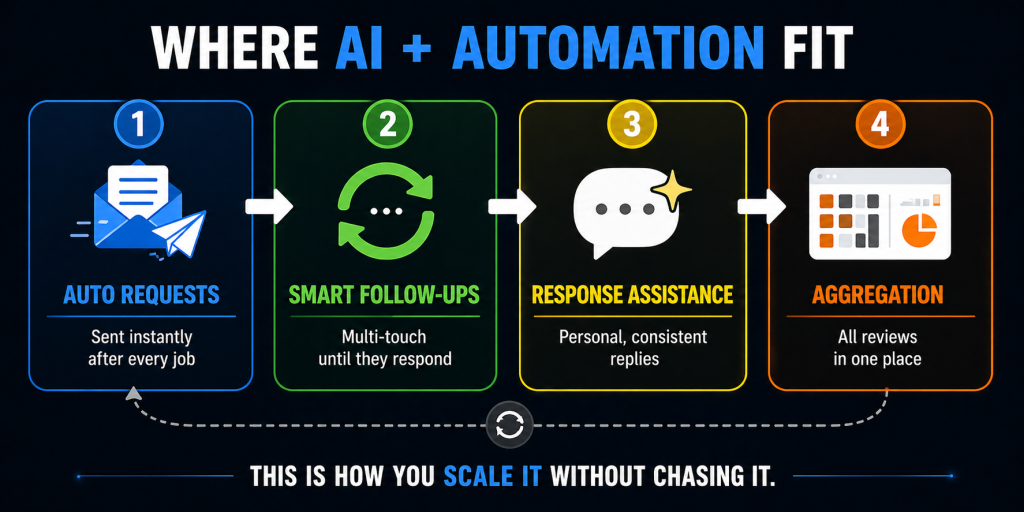
AI evaluates patterns. Automation ensures those patterns exist.
A strong review system combines human accountability with automated follow-up. The human layer makes the ask personal. The automation layer makes the process consistent.
Consistency in reviews builds trust faster than total review count.
Local Service Ads ranking is a trust-based bidding system influenced by responsiveness and review signals. Every completed job is either a lost signal or a future lead. For companies investing in LSAs, Google Local Service Ads management should account for review quality, review velocity, and conversion follow-up.
Google Is Telling You Exactly What It Wants
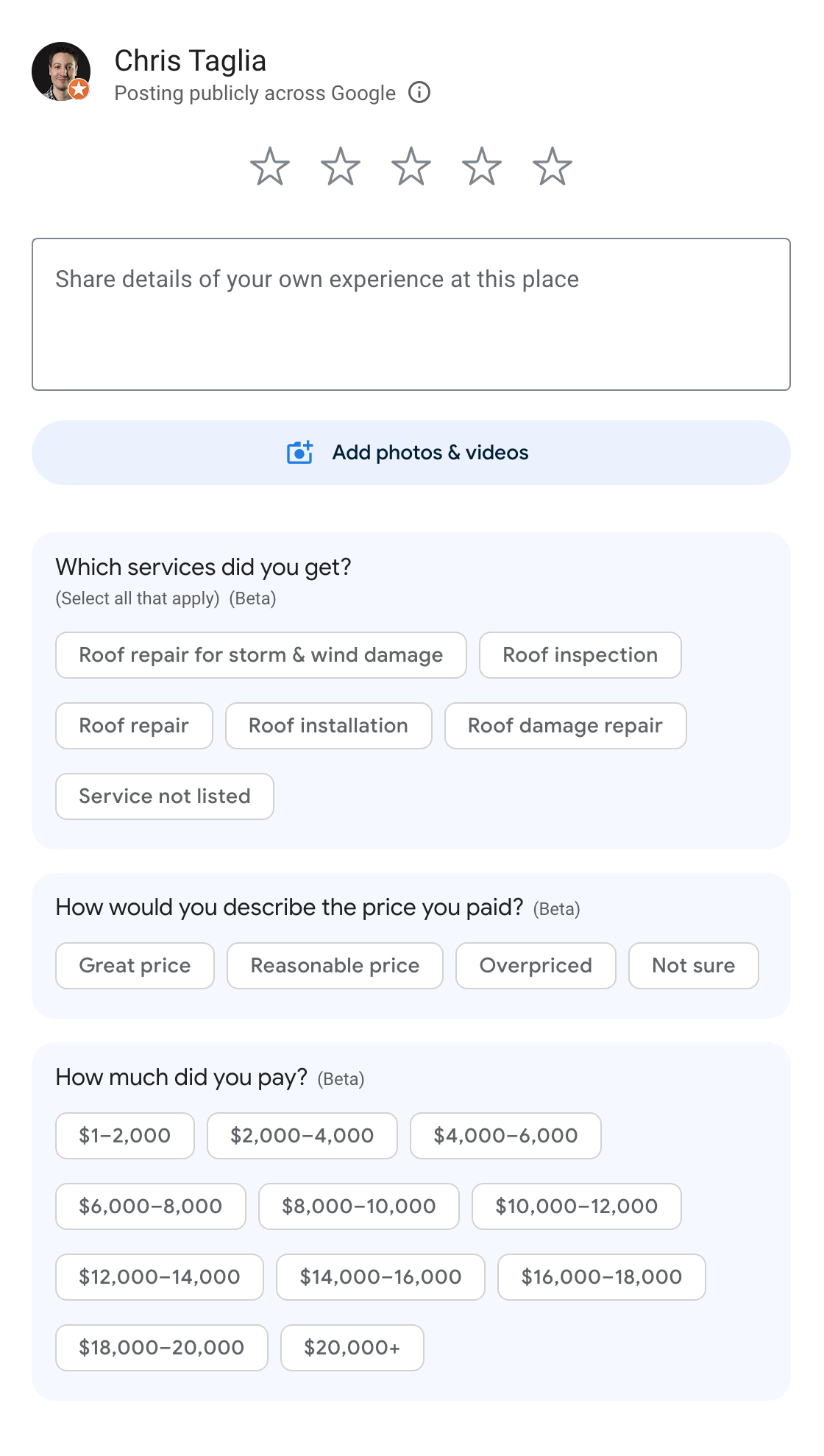
One of the biggest shifts in review strategy is this: Google is no longer vague about what matters. It is actively guiding users to provide the exact signals its system uses to rank and recommend businesses.
Originally, reviews were simple. Customers could write a review, rate their experience, and optionally upload photos. Over time, Google expanded that structure. First came photos, then videos. Now, Google prompts users to provide structured details about their experience.
- What service was performed
- How much the customer paid
- How they would describe the price or value
This is not a coincidence. Google is no longer just collecting opinions—it is collecting structured data.
Structured review data is information that helps AI systems understand not just that a customer was satisfied, but what was done, how it was done, and what it was worth.
If your reviews do not include these details, you are missing the exact signals Google is asking for.
Case Study: From Invisible to #1
Before implementation:
- 3 reviews in 6 months
- Not ranking in Google Maps
- 2–3 Local Service Ad leads per week
After implementing a structured review system:
- 1–2 reviews per week
- #1 position in Google Maps
- 6–7 Local Service Ad leads per week
- Competitor gap reduced from 51 reviews to 4
What This Proves
This demonstrates a clear cause-and-effect relationship. More consistent reviews increased visibility. Increased visibility produced more leads. Better messaging alignment improved conversion.
Structured reviews turn completed jobs into future opportunities.
Across accounts, the pattern is consistent: structured systems outperform isolated tactics.
Real-World Scenario: How the System Actually Works
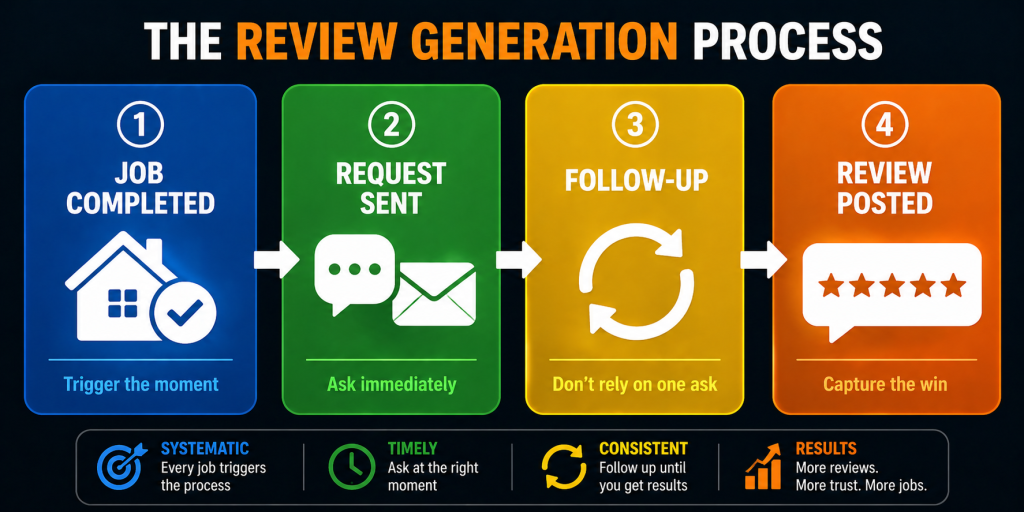
Before implementing a system, a typical job ends with no review request. Days or weeks pass, and no new signal is created. Visibility remains unchanged.
After implementing the system, the process changes. Immediately after job completion, a review request is triggered through both human follow-up and automation. The customer is guided on what to include, and the review is published within 24 to 48 hours.
If your reviews do not describe your work, AI cannot position your business.
The result is consistent signal generation, improved ranking stability, and increased lead flow.
Review Activity Scenario: Why Consistency Beats Totals
Two roofing companies can have similar ratings and still perform very differently.
Company A has 200 reviews, but the most recent review is three months old. Company B has 120 reviews and received two new reviews this week.
Company B may appear more often because AI and search systems prioritize activity, not just totals. Google does not rank opinions alone—it ranks patterns.
How Reviews Influence Commercial Roofing Jobs
Commercial buyers rely on proof, not popularity.
Reviews that include project details—such as building type, roofing system, materials, timelines, tenant coordination, and communication—act as micro case studies.
Commercial buyers do not look for popularity. They look for predictability.
A five-star residential repair review may build general trust, but it does not prove a contractor can handle a commercial reroof. A detailed review describing a multi-unit property, flat roof project, TPO installation, or HOA roofing job can directly influence vendor selection.
Search intent alignment is the match between what a user searches and what your reviews describe. If your reviews do not match commercial search intent, you do not exist in AI for those opportunities.

Decision Framework
This system is most effective for roofing companies that are not generating consistent reviews, are underperforming in Google Maps or Local Service Ads, or are closing leads well but do not have enough lead volume.
It is also valuable for companies expanding from residential into commercial roofing because it helps reviews communicate capability, not just satisfaction.
For roofers trying to connect search visibility, LSAs, website conversion, and lead flow into one growth system, Total Google Domination for roofers is the larger strategic framework.
This system should not be used to cover up operational problems. If service quality is weak, increased visibility will expose those problems faster.
Visibility amplifies reality.
5 Most Common Mistakes
- Waiting too long to ask for reviews
- Not guiding customers on what to include
- Ignoring or not responding to reviews
- Collecting reviews but not using them in marketing
- Relying on tools without a defined process
What This Does NOT Mean
This does not mean manipulating reviews, writing fake reviews, or chasing perfect ratings. It also does not mean replacing referrals.
The goal is to build a structured process that consistently captures real customer feedback and uses it correctly across search, AI, sales, and conversion assets.
Automation without accountability creates the illusion of a system.
Key Takeaways
- Reviews are visibility signals, not just feedback
- Consistency matters more than total volume
- Detailed reviews outperform generic ones
- Reviews influence both ranking and conversion
- Every completed job should generate a new signal
FAQs
How many reviews do I need to rank in Google Maps?
There is no fixed number of reviews required to rank in Google Maps because Google evaluates patterns rather than totals. Review consistency, recency, and relevance carry more weight than volume alone. A roofing company generating steady weekly reviews will often outperform competitors with more reviews but long periods of inactivity.
Do reviews impact Local Service Ads ranking?
Yes, reviews directly impact Local Service Ads ranking because they contribute to trust and engagement signals. Google evaluates how often you receive reviews, how you respond to them, and the quality of feedback. Strong, consistent reviews increase your visibility and improve your chances of receiving more qualified leads.
What makes a high-quality roofing review?
A high-quality roofing review includes specific details such as the type of service performed, the location, the customer experience, and the outcome. Reviews that mention materials, timelines, communication, and problem-solving provide stronger signals to both buyers and AI systems than generic feedback like “great job.”
How often should I be getting reviews?
Most roofing companies should aim for one to two reviews per week, depending on job volume. The key factor is consistency over time. Reviews that are evenly distributed create stable visibility signals, while clusters followed by inactivity reduce ranking strength and make your performance less predictable in search results.
Can AI actually use my reviews to rank me higher?
Yes, AI systems analyze review patterns, language, and engagement to determine relevance and authority. Reviews help AI understand what services you provide, where you operate, and how well you perform. Structured, detailed reviews improve your chances of appearing in both traditional search results and AI-generated responses.
What’s the fastest way to increase reviews?
The fastest way to increase reviews is to implement a structured post-job process that combines human follow-up with automation. Requesting reviews immediately after job completion and guiding customers on what to include improves both the quantity and quality of feedback, leading to better visibility and more consistent lead generation.
About the Author
Carm Taglia is the CEO of Roofing REV Marketing and has been in the marketing industry since 2001. With over 15 years of experience helping service-based businesses grow, he has worked with more than 250 companies and contributed to generating over $220 million in revenue. His team specializes in building systems that turn visibility into measurable growth for roofing companies competing in search, Maps, AI platforms, and Local Service Ads.
Methodology
This article is based on real-world implementation of review systems across roofing companies in competitive markets. Insights are drawn from observed changes in review velocity, Google Maps rankings, and Local Service Ad performance over time. The featured case study includes review growth from 3 reviews in 6 months to 1–2 reviews per week, a competitor gap reduction from 51 reviews to 4, Google Maps movement to the #1 position, and Local Service Ad lead growth from 2–3 weekly leads to 6–7 weekly leads.
Ready to See Where Reviews Are Costing You Jobs?
If your competitors are showing up more often—and getting more calls—your review system is likely the reason.
Start with a Visibility & Review Gap Analysis to identify exactly where you’re losing ground.
- How your review velocity compares to competitors
- What your reviews are missing and what AI is actually reading
- Why you’re gaining or losing position in Maps and LSAs
- What needs to change to turn your reviews into consistent jobs
This is not a generic audit. It is a breakdown of how your current review signals are impacting your visibility—and what to fix to generate more revenue.
The difference between ranking and getting skipped is not always your service. It is your signals.

LSA Budget for Roofers: Set It Right & Get More Leads
Your LSA budget doesn’t control how much you spend—it controls whether you get leads at all. For roofers using Google Local Service Ads, this is one of the most misunderstood parts of the platform. This guide is for roofing business owners and marketing managers who...
Google Local Service Ads vs Google Ads for Roofers
Google Local Service Ads vs Google Ads for roofers is one of the most important decisions when you want more roofing leads from Google. Most roofing companies think it comes down to one thing: pay per lead vs pay per click. That matters, but it is not the full answer....

How Roofers Should Dispute Bad Google Local Service Ad Leads
Dispute google local service ad leads is one of the most overlooked ways for roofers to control cost and improve profitability from LSAs. Most roofing companies focus on getting more leads. That’s only half the equation. If you’re paying for the wrong leads,...