

Google Local Service Ads management for roofers is the daily process of improving lead handling, response speed, reviews, disputes, and profile activity after your LSA account is live. If your roofing company is verified but not getting consistent leads, the problem usually is not setup. It is the system behind the account.
Direct Answer: Local Service Ads Management for Roofers means actively managing calls, messages, booked lead status, reviews, disputes, service areas, business hours, photos, and lead feedback so Google sees your roofing company as responsive, active, and trustworthy.
Executive Summary
Google Local Service Ads are not just a pay-per-lead platform. They are a performance-based ranking system. Roofing companies that consistently manage calls, leads, reviews, and profile activity earn more visibility and better leads over time. The difference between profitable LSAs and wasted spend is not budget. It is operational discipline.
What Is Local Service Ads Management for Roofers?
Local Service Ads management for roofers is the ongoing work that happens after your roofing company’s LSA profile is approved. It includes answering calls quickly, responding to message leads, updating every lead, requesting reviews, disputing invalid leads, and keeping your profile active.
This is where many roofing companies lose momentum. They get verified, turn the ads on, and assume the platform will keep sending leads automatically. That is not how LSAs work. Google is constantly evaluating how your company handles the opportunities it receives.
Google Local Service Ads Management Explained
Google Local Service Ads management is the continuous optimization of a roofing company’s responsiveness, review activity, and lead handling to improve visibility. Google LSAs are a trust-based ranking system where operational behavior, not just ad spend, determines how often your business appears.
| LSA Setup | LSA Management |
|---|---|
| Creates the account | Improves performance after launch |
| Verifies business information | Monitors lead quality and account activity |
| Sets services and service areas | Adjusts services and areas based on results |
| Adds budget | Controls budget based on capacity and demand |
| Turns ads on | Keeps calls, reviews, disputes, and lead updates moving |
What Managing Google Local Service Ads Actually Means
Google Local Service Ads require an ongoing management process after activation to increase both lead volume and lead quality. This is not setup. This is operational behavior.
It includes answering calls quickly, responding to message leads, managing every lead in the dashboard, generating consistent reviews, keeping your Google Business Profile active, and providing accurate feedback to Google. Local Service Ads management is the system that determines your visibility, not just your budget.
Most roofing companies think the work is finished once the profile is approved and ads go live. That is where the actual work begins.
Google is not just selling leads. Google is ranking your business based on how you operate after those leads come in. In Local Service Ads, behavior functions as part of the ranking system. If your business answers calls fast, updates leads consistently, keeps reviews coming in, and stays active, visibility can improve. If those behaviors are inconsistent, performance usually declines over time even when the account remains active.
Why Most Roofing Companies Fail With LSAs
Most roofing companies approach LSAs like traditional advertising.
They assume more budget equals more leads, leads should arrive automatically, and no daily management is required once the campaign is live. That is usually where performance starts to break down.
Google Local Service Ads are a trust-based ranking system, not a traffic-buying platform. Google evaluates responsiveness, customer experience, account activity, and lead feedback because its goal is to connect homeowners with roofing contractors who are most likely to provide a good experience.
This is why many contractors say LSAs “stopped working.” In most cases, the ads did not randomly stop. The system reacted to weaker performance signals. Managed accounts gain visibility over time. Unmanaged accounts lose it, even with higher budgets.
That distinction matters because it changes how you should think about optimization. The question is not just, “How much should we spend?” The better question is, “What signals are we sending Google every day?”
For a deeper breakdown of that problem, see why roofing Local Service Ads stopped working.
How Google Decides Who Gets the Leads
Google prioritizes roofing companies that create the best experience for homeowners searching for help. LSA ranking is not based on budget alone. According to Google, Local Services Ads rankings use an auction that considers bid and overall profile quality. Google specifically lists responsiveness, missed calls, search relevance, services offered, business bio, ratings, review count, average response time, high-quality images, and verification checks as ranking factors.
You can review Google’s official explanation of Local Services Ads ranking factors.
The core performance signals usually include:
- Call answer speed
- Missed call rate
- Message response time
- Review consistency and recency
- Lead management behavior inside the dashboard
- Profile activity
- Proximity to the searcher
- Service relevance
Google’s goal is straightforward. It wants to connect homeowners with roofing companies that respond quickly, manage inquiries properly, and appear trustworthy.
Google Local Service Ads reward responsiveness, not just budget. That means answering calls within 15 to 20 seconds does more than improve your booking chances in the moment. It can also improve future visibility because Google sees that behavior as a positive performance signal.
Missed calls do not just lose leads. They can reduce future visibility.
That cause-and-effect relationship is what most roofing companies miss. They focus on what happened with one lead, while Google is evaluating what that interaction says about the overall business. Behavior drives visibility. Visibility drives leads.
If you want to go deeper on response time specifically, see how fast roofers should answer Local Service Ad calls.
The Economics of Roofing LSAs
When managed correctly, LSAs are one of the most efficient lead sources available to roofing companies. Based on industry averages and real-world client experience, typical performance looks like this:
- Average cost per lead: $50 to $125
- Average cost per customer: $125 to $300
- Average residential roofing revenue per job: about $20,000
That average job value can include everything from a $500 shingle repair to a full metal roof replacement that costs more than $45,000. The point is not that every lead becomes a large job. The point is that even a modest close rate can create a strong return when the lead cost stays this low.
Example Math
If a roofing company spends $500 to $1,250 to generate 10 leads, and 3 to 4 of those leads become customers, the resulting revenue can be in the $60,000 to $80,000 range at a $20,000 average job value.
What this proves: small improvements in response speed, intake quality, and follow-up create outsized differences in return on investment. A company that answers quickly, books inspections effectively, and follows up consistently can make LSAs look incredibly profitable.
A company that misses calls and lets leads sit can make the same platform feel expensive. Across accounts, the pattern is consistent: companies that improve responsiveness and lead handling lower their cost per customer and increase booked revenue without increasing spend.

The 10-Step System Behind Consistent Roofing Leads
Consistent LSA performance is not random. It is operational. The roofing companies that generate steady LSA jobs tend to follow the same habits over and over.
This system is based on real workflows and internal operating habits already outlined in your source material and supporting resources. The point is not to create more tasks for the sake of it. The point is to strengthen the signals Google uses to decide who gets future opportunities.
1. Answer Every Call Like It Is a $20,000 Roof
Every incoming LSA call could represent a large residential job. Answering calls within 15 to 20 seconds improves both your chance of booking the appointment and the performance signals Google sees in the account. Calls should route to a real person whenever possible. Avoid phone trees, long hold times, and complicated menu systems.
2. Respond to Message Leads Immediately
Homeowners often contact multiple roofers at once. The company that responds first frequently wins the inspection appointment. Fast responses create two benefits at the same time: better homeowner engagement and stronger account performance signals.
3. Manage Every Lead the Same Day
Google expects activity inside the LSA dashboard. Leads should be reviewed, categorized, and updated once you know the outcome of the first interaction. If an estimate or inspection is scheduled, mark the lead accordingly. If the lead is invalid, archive it. Leaving leads unmanaged sends a negative signal.
4. Rate Leads Based on Quality, Not Just Outcome
Lead rating is not about whether you won the job. It is about whether the lead was legitimate and relevant. A homeowner who genuinely needed roof work but hired another contractor can still be a good lead. Accurate lead feedback helps Google improve future lead matching.
5. Build Review Momentum Weekly
Reviews do more than influence trust with homeowners. They also strengthen visibility signals in LSAs. Consistency matters more than one large burst. A steady flow of new reviews tells Google your business is active and trusted.
Consistent weekly reviews increase trust signals, which directly improves LSA visibility and lead flow. For more on that connection, see how reviews power Google Local Service Ads.
6. Keep Your Profile Active
An active Google Business Profile supports your LSA performance. Uploading fresh job photos and maintaining current business information helps show that your company is engaged and operating. Completed roofs, crews at work, before-and-after images, and real project photos all support that signal.
7. Review and Dispute Invalid Leads
Not every lead is valid. Roofing companies should dispute spam, duplicates, wrong-service inquiries, and leads outside their service area when appropriate. This protects your budget and improves Google’s understanding of what qualifies as a good lead for your business.
See how roofers should dispute bad Google Local Service Ad leads for the supporting process.
8. Adjust Budget Based on Demand, Not Emotion
Your LSA budget affects how many leads you can receive, but it does not override weak performance signals. If leads are shutting off early in the week, or demand increases after storms, increasing budget may make sense. But budget increases do not fix missed calls, slow response times, or unmanaged leads.
Visibility in LSAs is earned through consistency, not increased spend. For budget guidance, see LSA budget for roofers.
9. Track Every Lead in Your CRM
LSAs generate the opportunity. Your system determines whether that opportunity becomes revenue. Track the lead source, customer information, service needed, scheduled inspection, estimate outcome, and final job status. Better follow-up usually produces more revenue from the same lead volume.
10. Pause Ads When You Cannot Handle Leads Properly
If your team cannot answer calls, respond to messages, or schedule work promptly, pausing ads is often better than allowing performance signals to deteriorate. That may feel counterintuitive, but it protects future visibility. A missed-call problem today can create a visibility problem tomorrow.
Roofing LSA Management Checklist
Roofing LSA management works best when it is handled through a repeatable operating rhythm. The goal is not to “check the ads” once in a while. The goal is to keep the account active, accurate, and responsive every day.
| Daily | Weekly | Monthly |
|---|---|---|
| Answer every LSA call quickly | Dispute invalid leads | Review services offered |
| Respond to message leads within minutes | Request new Google reviews | Refine service areas |
| Update lead status the same day | Upload new job photos | Analyze call handling |
| Mark booked inspections | Review missed calls and slow responses | Review message quality and booking rates |
| Archive invalid leads | Check budget pacing | Adjust budget based on demand and capacity |
These routines matter because consistency compounds. The businesses that maintain these habits tend to produce stronger performance signals over time, which tends to produce stronger visibility and more leads.
High-performing roofing companies treat LSAs like an operating system. Others treat them like ads and plateau. For the full process breakdown, see Google Local Service Ads daily routine for roofers.
Google Local Service Ads vs Google Ads for Roofers
Google Local Service Ads and Google Ads can both generate roofing leads, but they work very differently. Local Service Ads are built around trust, responsiveness, and lead handling. Google Ads are built around keywords, bidding, ad copy, landing pages, and click efficiency.
| Factor | Google Local Service Ads | Google Ads |
|---|---|---|
| Pricing model | Pay per lead | Pay per click |
| Lead intent | Usually higher intent | Mixed intent |
| Volume potential | Limited | More scalable |
| Control level | Lower | Higher |
| Operational dependency | Very high | High, but different |
LSAs are the foundation channel. Google Ads is the scaling channel.
That matters because roofing companies that start with LSAs often build the intake habits they need before moving into higher-volume channels. Once you scale into Google Ads or paid social, lead volume tends to increase while average lead quality often becomes more mixed. That requires faster response, better follow-up, and a more mature intake system.
For a deeper breakdown, see Google Local Service Ads vs Google Ads for roofers.
“We include Google Local Service Ads in every package because they force roofing companies to build the right system. LSAs don’t just generate leads. They train your team how to handle them properly. You get high-intent calls without being overwhelmed, which makes them ideal for building consistency in your intake and follow-up process.
The reality is, you won’t get unlimited volume. Demand is higher than supply in most markets. But that’s exactly why these leads are so valuable.
They’re some of the lowest-cost, highest-intent opportunities available outside of referrals. When you scale into channels like Google Ads or social, volume increases but quality drops. That requires faster response times, stronger follow-up, and a more advanced system. LSAs are where roofing companies should start because they build the foundation that everything else depends on.”
— Chris Taglia, COO, Roofing REV Marketing
When LSAs Make Sense and When They Do Not
LSAs are a strong fit for many roofing companies, but they are not the right answer for every situation.
When to Use LSAs
- You want high-intent roofing leads
- You need predictable, controlled volume
- You are building or refining your intake process
- You want a lower-cost lead source than many paid channels
When Not to Rely on LSAs Alone
- You need aggressive volume and scale
- You cannot answer calls quickly
- You do not have a working follow-up system
- You expect budget increases to solve operational issues
If you cannot answer calls quickly, LSAs will underperform regardless of budget. If you need volume, LSAs alone will not scale enough in most markets.
This is why the strongest strategy is usually not “LSAs or Google Ads.” It is “Use LSAs to build the foundation, then add volume channels when the system is ready.”
What Hurts LSA Performance the Most
The biggest LSA problems are usually operational, not technical.
- Missed calls
- Slow response times
- Ignoring leads in the dashboard
- Inconsistent review generation
- Inactive profiles
- Wrong services selected
- Service areas that do not match real capacity
These are negative performance signals. Each one reduces Google’s confidence that your business will create a good homeowner experience.
Fast responders get more opportunities. Slow responders get fewer. This is where many roofing companies lose performance, not because the market stopped searching, but because the account stopped sending strong trust signals.
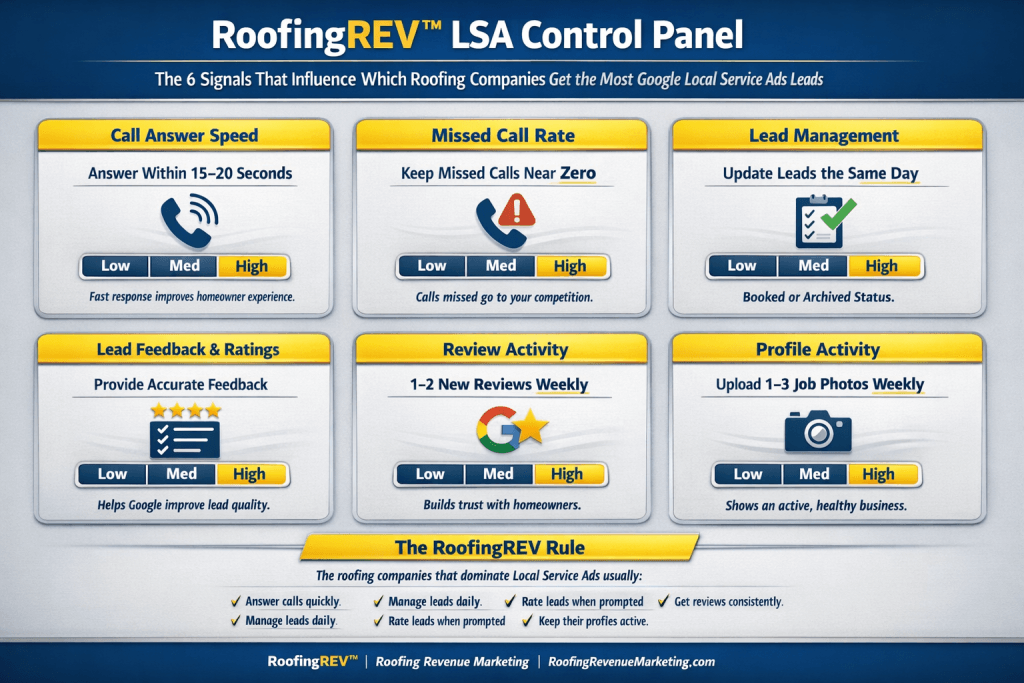
What Improves LSA Performance
Strong LSA performance comes from consistency more than tactics.
- Fast call answering
- Quick message responses
- Daily lead management
- Consistent review generation
- Active Google Business Profile updates
- Accurate lead feedback
- Clean call routing
- Clear intake process
Each of these actions strengthens the same core signal: your roofing company is responsive, active, and reliable.
Lead volume is controlled by performance signals, not demand alone. That is why a company can be in a strong market and still feel disappointed with LSAs. Market demand matters, but performance determines how much of that demand reaches your business.
Common Mistakes Roofing Companies Make With LSAs
Mistake 1: Treating LSAs Like Ads
LSAs are not just a pay-per-lead ad product. They are a trust-based ranking system. Treating them like a simple media buy causes roofing companies to overlook the operational behaviors that drive visibility.
Mistake 2: Using Budget Increases to Try to Fix Performance
Budget can affect lead volume, but it does not override poor responsiveness, weak review activity, or unmanaged leads. Spending more on a weak system usually amplifies the underlying problem.
Mistake 3: Ignoring or Delaying Lead Management
When leads sit unreviewed, Google sees inactivity. Updating leads the same day tells the system your account is engaged and operating properly.
Mistake 4: Underestimating the Role of Reviews
Reviews are not just for SEO or homeowner trust. In LSAs, they contribute directly to the trust signals that influence visibility.
Mistake 5: Treating Missed Calls Like a Minor Problem
Calling back later may recover some opportunities, but Google still records the missed call. The system is evaluating how you handle leads in the moment, not just whether you eventually return them.
For the expanded version, see 5 mistakes killing roofing companies’ Google LSAs.
What This Does Not Mean
Clarifying what LSAs are not is just as important as explaining what they are.
- LSAs are not fully controllable
- Not every lead will close
- They do not replace every other marketing channel
- They are not built for unlimited scale
- They do not fix weak intake
This does not mean LSAs are weak. It means they work best when understood correctly. They are a high-intent, lower-volume lead source that rewards operational consistency.
LSAs are not a replacement for marketing strategy. They are a force multiplier for roofing companies with strong intake discipline.
Real-World Example: What the Math Actually Looks Like
Here is a simple example using the average numbers discussed earlier.
- $1,000 in spend
- About 10 to 15 leads
- A 30% close rate
- 3 to 5 booked jobs
- Roughly $60,000 to $100,000 in revenue at a $20,000 average job value
What this proves: conversion and operational discipline matter more than raw lead volume.
A roofing company does not need endless leads to create strong returns from LSAs. It needs to convert the opportunities it receives. That is why intake quality, call handling, and follow-up are so central to performance.
Across roofing companies, the pattern is consistent: the businesses that treat LSAs as a system outperform those that treat them as ads.
Key Takeaways
- Google Local Service Ads are a ranking system, not just an ad product.
- Your behavior determines your visibility.
- Fast response and consistency outperform budget increases.
- Small operational improvements can create large revenue gains.
- LSAs are one of the best foundation channels for high-intent roofing leads.
LSAs reward roofing companies that are responsive, consistent, and engaged. The businesses that treat them like a system usually generate more leads at lower costs over time. The businesses that treat them like ads often lose momentum, even when demand exists in the market.
FAQ
How do you manage Google Local Service Ads for a roofing company?
Managing Google Local Service Ads for a roofing company requires a consistent daily process focused on responsiveness and lead handling. This includes answering calls within 15 to 20 seconds, responding to messages quickly, updating lead statuses the same day, requesting reviews weekly, and maintaining an active profile. These actions improve performance signals, which directly increase visibility and lead volume.
Why did my Google Local Service Ads stop working?
Google Local Service Ads typically stop working when performance signals decline. Missed calls, slow response times, unmanaged leads, inconsistent reviews, or an inactive profile can all reduce visibility. LSAs reward responsiveness and consistency, so even small breakdowns in these areas can significantly reduce lead flow.
How many reviews do you need for Local Service Ads?
There is no fixed number of reviews required for Local Service Ads, but consistency is critical. Most successful roofing companies aim to generate 1 to 2 new reviews per week per location. A steady flow of recent reviews increases trust and signals to Google that your business is active, which helps improve visibility.
Should you mark Google LSA leads as booked right away?
You should update Google LSA leads as soon as you know the outcome of the first interaction. If an inspection or estimate is scheduled, mark the lead as booked. If the lead is invalid, archive it. Prompt updates signal activity to Google and help maintain strong performance.
Does disputing Local Service Ads leads hurt performance?
Disputing Local Service Ads leads does not hurt performance when done correctly. Roofing companies should dispute leads that are spam, duplicate, outside their service area, or unrelated to roofing services. This helps recover costs and improves future lead quality by giving Google accurate feedback.
Are Google Local Service Ads better than Google Ads for roofing companies?
Google Local Service Ads are better for generating high-intent, lower-volume leads, while Google Ads are better for scaling traffic and increasing volume. LSAs reward responsiveness and trust, while Google Ads rely on budget, targeting, and optimization. Most roofing companies benefit from using LSAs as a foundation and Google Ads for growth.
About the Author
Chris Taglia is the COO of Roofing REV Marketing and has been working in digital marketing since 2008, with more than 15 years of experience helping service-based businesses grow. He has helped market more than 250 businesses and contributed to generating over $220 million in revenue across service industries. His current focus is helping roofing companies build predictable lead systems using Google Local Service Ads and other performance-driven channels.
This guide is based on real-world account management, not theory, and is built from repeated patterns observed in live roofing campaigns.
Methodology
Data source: live Google Local Service Ads accounts and internal campaign workflows.
Sample type: roofing company LSA accounts managed using consistent operating processes.
Time frame: based on accumulated management experience and observed account patterns during active campaign operations.
Data type: operational observations, lead cost ranges, customer acquisition ranges, call handling patterns, review activity trends, and conversion-related performance signals.
The conclusions in this article are based on repeatable patterns seen across roofing accounts, not isolated examples.
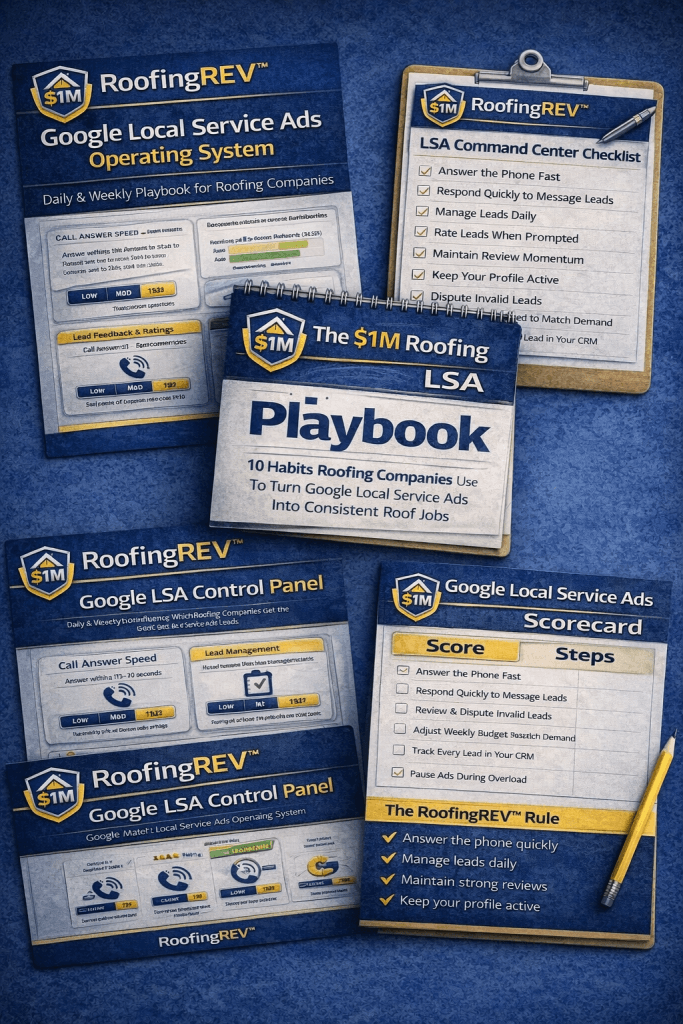
Download the Local Service Ads System for Roofers
If you want to turn Local Service Ads into a predictable source of roofing jobs, you need more than setup. You need a system.
Download the LSA Playbook and Operating System to see the exact daily, weekly, and monthly process high-performing roofing companies use to improve response speed, increase lead quality, and generate more booked jobs from the same number of leads.
This resource is designed to help roofing companies build the intake discipline and operating habits that make LSAs profitable before they try to scale into higher-volume channels.
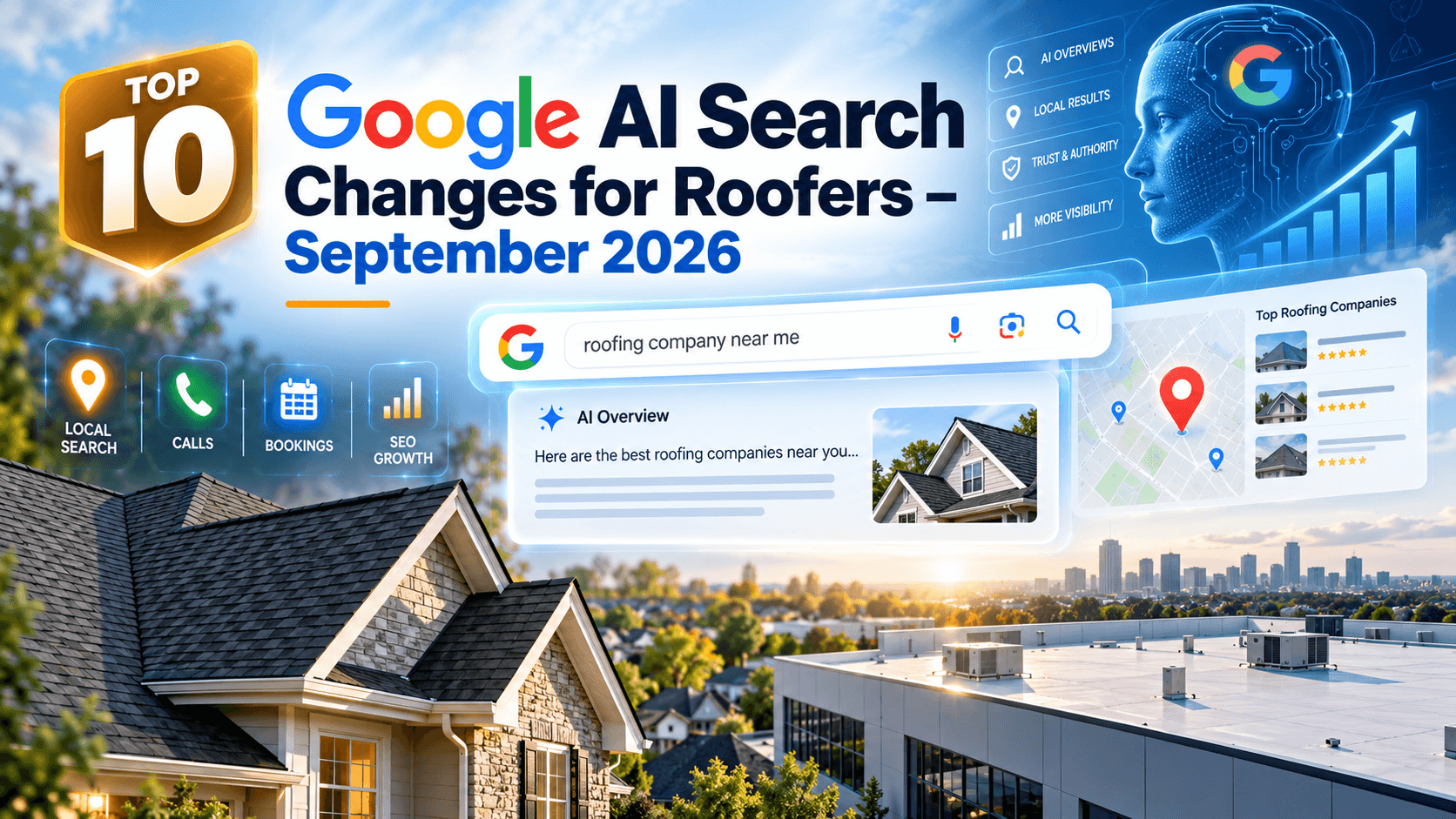
Top 10 Google AI Search Changes for Roofers – September 2026
For roofing and exterior companies, recent changes across Google Search, AI results, Maps, Local Services Ads, and Google Business Profiles are affecting more than rankings. They are changing how homeowners discover contractors, research their options, make contact,...
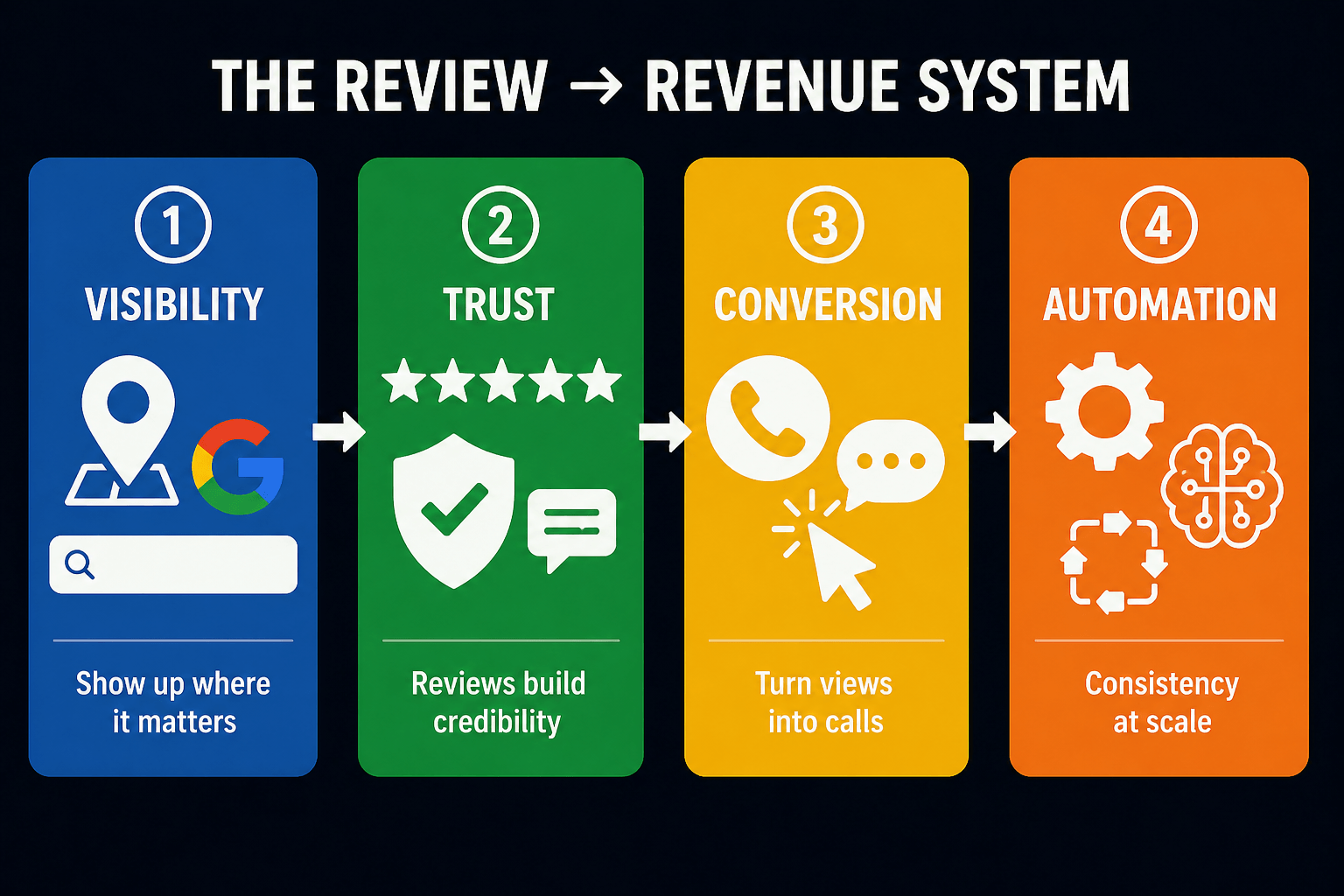
How AI Turns Roofing Reviews Into More Jobs
How AI actually turns reviews into roofing jobs is now one of the most important drivers of visibility, trust, and revenue for roofing companies competing in Google Maps, Local Service Ads, and AI search results. This guide is for roofing business owners and marketing...

LSA Budget for Roofers: Set It Right & Get More Leads
Your LSA budget doesn’t control how much you spend—it controls whether you get leads at all. For roofers using Google Local Service Ads, this is one of the most misunderstood parts of the platform. This guide is for roofing business owners and marketing managers who...