
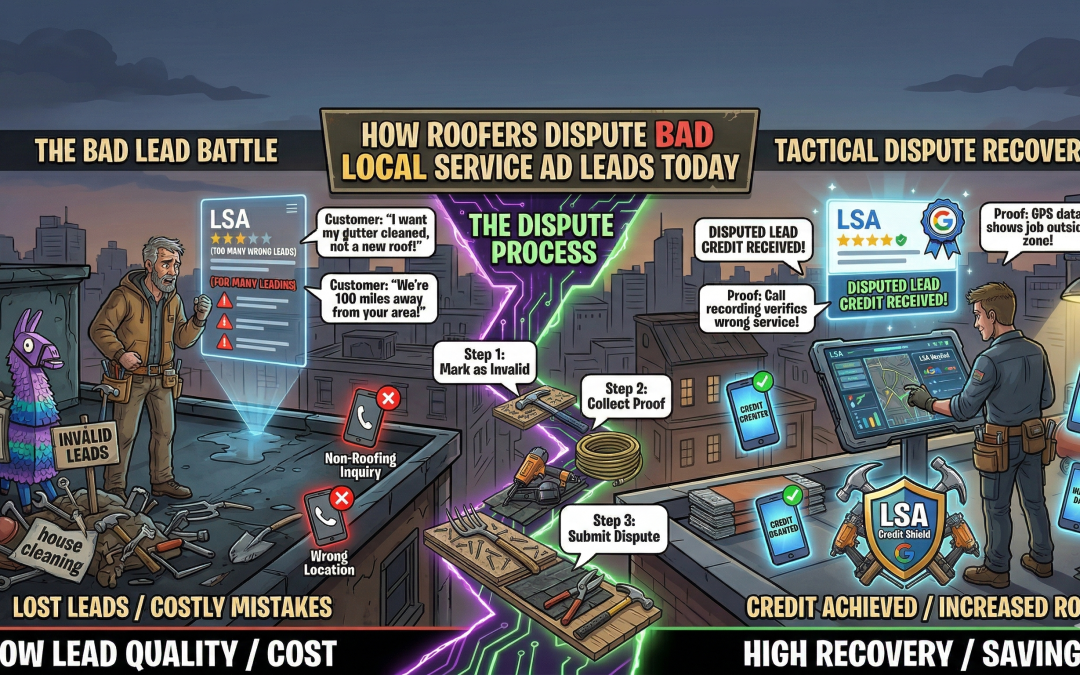
Dispute google local service ad leads is one of the most overlooked ways for roofers to control cost and improve profitability from LSAs.
Most roofing companies focus on getting more leads. That’s only half the equation. If you’re paying for the wrong leads, increasing volume only amplifies wasted spend. The real leverage comes from controlling both lead quantity and lead quality.
If you want to understand how LSAs are meant to be managed as a system, start here:
Google Local Service Ads Management for Roofing Companies.
Table of Contents
- Why You’re Paying for Bad LSA Leads
- What Most Roofers Get Wrong About LSA Leads
- What Actually Qualifies as a Bad Lead
- How the LSA Dispute System Really Works
- How to Dispute Google Local Service Ad Leads (Step-by-Step)
- How Often You Should Dispute LSA Leads
- Why Disputing Leads Improves ROI
- The Truth: Disputing Leads Does NOT Reduce Lead Volume
- Why Trying to Game the System Will Hurt You
- Real-World Scenarios
- Implementation Framework
- FAQ
Why You’re Paying for Bad LSA Leads
If you’re running Local Service Ads, you’ve already experienced irrelevant calls, out-of-area requests, and spam.
Most contractors accept this as normal. That assumption quietly reduces profitability over time.
The reality is that bad leads are expected, but unmanaged bad leads are not. If you are not actively reviewing and labeling them, you are allowing wasted spend to accumulate without correction.
A few bad leads per week may seem minor, but over time this compounds into a meaningful loss that most companies never track.
What Most Roofers Get Wrong About LSA Leads
The biggest mistake with LSAs are confusing a lost job with a bad lead.
A legitimate homeowner who contacted you for roofing work is still a valid lead, even if they chose someone else. That is a real opportunity.
The second mistake is assuming disputes are about refunds.
They are not. They are about improving match quality.
When your feedback is accurate and consistent, Google gets better at sending you the right types of jobs.
What Actually Qualifies as a Bad Lead
A bad lead is defined by mismatch, not outcome.
If the lead does not align with your services, your service area, or a real customer need, it is invalid. This includes wrong services, out-of-area requests, spam calls, and duplicate leads.
Legitimate inquiries, even if they don’t convert, should never be treated as bad leads.
How the LSA Dispute System Really Works
Google evaluates multiple signals together:
- Call recordings
- Message transcripts
- Lead status
- Ratings
- Notes
This creates a feedback loop.
When your feedback aligns with what actually happened, the system improves. When it doesn’t, your input becomes less reliable over time.
You are not submitting disputes. You are training a system that learns from your behavior.
This is the same system that powers trust signals like reviews:
How Reviews Power Google Local Service Ads.
How to Dispute Google Local Service Ad Leads (Step-by-Step)
1. Review Every Lead Immediately
Review calls and messages as they come in or the same day. Delayed reviews reduce accuracy and weaken your ability to control outcomes.
2. Determine If the Lead Is Valid or Invalid
Evaluate based on service, location, and legitimacy, not whether you closed the job.
3. Mark the Lead Status Right Away
Archive invalid leads immediately. Do not leave leads unassigned or revisit them later.
4. Rate the Lead Accurately
Rate based on quality, not outcome. This directly impacts how Google evaluates similar leads in the future.
5. Add Clear Notes Explaining the Issue
Use short, specific notes like “outside service area” or “wrong service requested.” This reinforces transcript data and improves both credit decisions and future matching.
6. Let the System Process the Outcome
Credits are handled automatically. Your role is to provide accurate inputs, not force results.
How Often You Should Dispute LSA Leads
Lead management should happen immediately or daily. Every lead should be reviewed, rated, and categorized as soon as possible.
In addition, conduct a weekly review to identify patterns and confirm no leads were missed. This combination of daily action and weekly review is what drives consistent improvement.
Why Disputing Leads Improves ROI
Every invalid lead that goes unmanaged reduces your margin.
Over time, those losses compound. More importantly, consistent feedback improves lead quality, which increases conversion rates and reduces wasted spend.
A strong LSA account doesn’t eliminate bad leads. It controls the percentage of them.
The Truth: Disputing Leads Does NOT Reduce Lead Volume
Accurate feedback improves match quality.
Google wants homeowners connected to the right businesses. When your feedback helps eliminate mismatches, the system becomes more efficient.
Better matches lead to better performance, not fewer leads.
Why Trying to Game the System Will Hurt You
Google compares your feedback against actual conversations.
If your ratings and notes don’t align with reality, your input becomes less trusted. When that happens, lead quality declines and performance suffers.
This system rewards accuracy over time, not shortcuts.
Real-World Scenarios
Contractors who ignore lead management lose margin gradually.
Those who try to manipulate the system create instability and declining results.
The highest-performing companies manage leads daily, provide accurate feedback, and allow the system to improve over time.
Implementation Framework
Start by auditing your leads and identifying how many are invalid.
Then build a system where every lead is reviewed, rated, and categorized immediately. Weekly reviews should focus on patterns, not cleanup.
Use those patterns to refine your targeting and improve results.
Key Takeaways
- Disputing leads is about improving match quality
- Immediate lead management is critical
- Ratings and notes are key signals
- Bad leads compound into lost margin
- Accuracy improves long-term performance
Final Perspective
Local Service Ads are not just a lead source. They are a system.
The contractors who win are the ones who manage leads daily, provide accurate feedback, and stay consistent.
That’s what drives better leads, higher conversion rates, and stronger ROI.
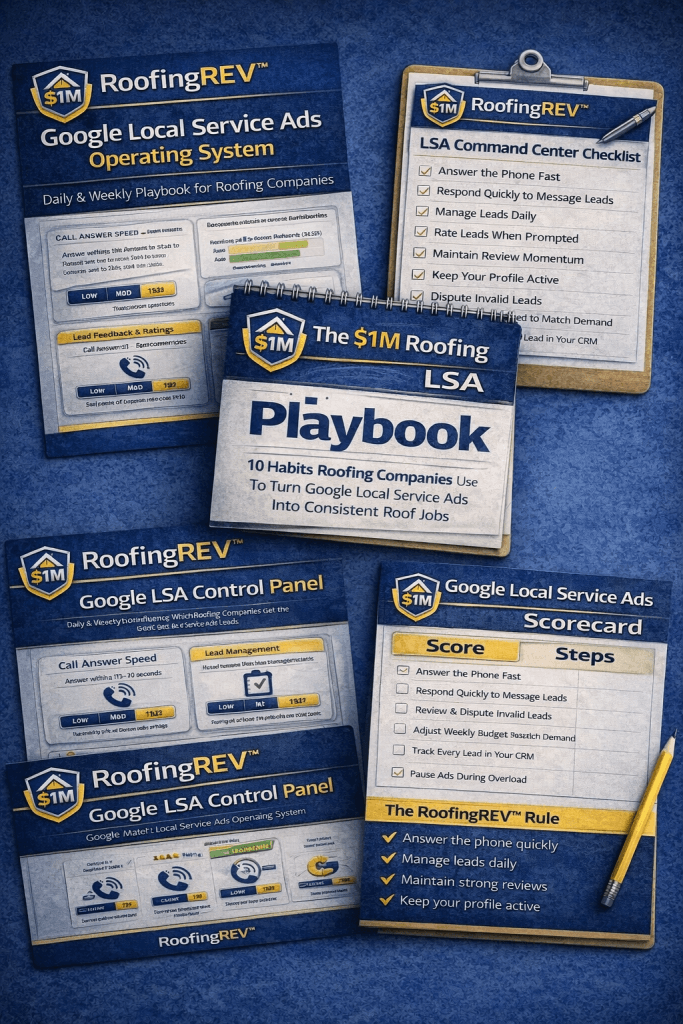
If you want predictable, high-quality LSA leads, you need a system, not guesswork. Download the full framework and see exactly how top roofing companies scale this channel.
FAQs
What qualifies as a bad lead in Google Local Service Ads?
A bad lead is one that does not match your services, service area, or a real customer need. This includes spam calls, wrong services, duplicate leads, or out-of-area requests. A homeowner who needed roofing work but chose another contractor is still considered a valid lead and should not be disputed.
How do you dispute a Google Local Service Ads lead?
Disputing is handled through proper lead management. You review the lead, mark it as archived if invalid, rate it accurately, and add notes explaining the issue. Google then uses transcripts and your feedback to automatically determine whether a credit is issued.
How often should you dispute LSA leads?
Leads should be reviewed, rated, and categorized immediately or daily as they come in. In addition, a weekly review ensures all leads are properly managed and helps identify patterns that can improve future lead quality and reduce wasted spend.
Does disputing LSA leads reduce your lead volume?
No. Accurate feedback improves how Google matches leads to your business. When you consistently identify invalid leads, the system becomes more efficient, which leads to better quality leads and improved performance rather than reduced volume.
Can you get a refund for bad Google LSA leads?
Yes, but it is automated. Google reviews call recordings, message transcripts, and your feedback to determine whether a lead qualifies for credit. Your role is to provide accurate ratings, notes, and lead status so the system can make the correct decision.
What happens after you dispute a lead?
Google evaluates the lead using transcripts and your feedback. If the lead is determined to be invalid, a credit may be issued. Over time, your feedback also improves how future leads are matched, increasing overall lead quality.
Should you dispute every lead you don’t close?
No. A lead that does not convert can still be valid. Only dispute leads that are clearly invalid, such as wrong services, spam, or out-of-area requests. Disputing valid leads can reduce trust in your feedback and hurt performance.
How long do you have to dispute LSA leads?
Google provides a limited window to review and manage leads, which is why immediate and weekly review is critical. Waiting too long can result in missed opportunities to flag invalid leads and recover potential credits.
How Reviews Power Google Local Service Ads
Reviews are one of the most important factors in determining how many leads your business gets from Google Local Service Ads. Most roofing companies treat reviews as reputation. In reality, Google reviews are a ranking signal, trust signal, and conversion driver...

ADA Compliance for Roofing Websites + $5K Tax Credit
ADA compliance for roofing websites is no longer optional, and most roofing companies are exposed without knowing it. Most roofers think ADA laws only apply to buildings. They don’t. Your website is part of your business. If someone cannot use it because of a...

How Fast Roofers Should Answer Google Local Service Ad Calls
If you’re wondering how fast to answer Google Local Service Ad calls for your roofing company, the answer is not flexible—and it directly impacts how many leads your roofing business receives. Most roofing companies treat response time as a sales issue. In reality,...