
A smaller roofing company can compete with a larger roofing contractor that’s been around for decades, even with a smaller marketing budget and fewer Google reviews. The key is to stop trying to compete for every service in every city. Focus your marketing on ONE profitable roofing service or geographic area, establish a strong position in that market, and expand from there.
AI search creates another opportunity for smaller roofing companies. When property owners ask ChatGPT or Google’s AI for contractors with experience handling a particular type of roofing project, a smaller company may be a good match. But you need to make that experience visible through real projects, useful website content, photos, customer reviews, and information about your team.
We’ll cover how smaller roofers can compete with established contractors on Google Search, Google Maps, and AI recommendations, how being family-owned or locally operated can work to your advantage, and where to concentrate your marketing efforts to attract more qualified customers and profitable roofing jobs.
Stop Trying to Compete With Bigger Roofing Companies Everywhere
Here’s where being a smaller roofing company can actually work in your favor.
Think about it.
Your larger competitors might be trying to rank for roofing, gutters, siding, storm damage, roof replacement, and commercial roofing across 10, 15, or even 20 different cities.
They have more employees, more trucks, more marketing dollars, and probably a website with hundreds of pages.
But they also have a lot more ground to cover.
You don’t have to do all that. At least not yet.
Instead of spreading your marketing budget across every service and every city, put more of your resources into winning ONE service or ONE market.
For example:
Big roofing company:
- Roofing, gutters, and siding
- South Elgin, Elgin, Aurora, St. Charles, Geneva, Batavia, and surrounding Kane County communities
- Multiple crews and service divisions competing across the region
Smaller roofing company:
- Roofing services concentrated in South Elgin
- Metal roofing throughout Kane County
See the difference?
You’re not trying to outrank that company for every roofing-related search across the entire county.
You’re choosing a battle you have a realistic chance of winning.
As I explained in the video:
“You can put your time, money, and effort into ONE service or ONE city. Once you’re ranking well and taking a good chunk of that market share, then ADD another service or city. Keep doing that, one by one.”
That’s how a smaller business can build market share without having to match a larger competitor’s marketing budget.
How Do We Decide Which City a Roofing Company Should Target First?
We usually start with the city where the roofing company’s business address is located.
Why?
Because Google Maps considers distance when determining local search results, and your actual business location matters.
From there, we look at neighboring cities. But we don’t just start targeting every city within a 30-mile radius.
We look at where the business opportunities actually are.
For residential roofing companies, that means looking at things like:
- Home values: What are properties worth in that area, and does the market fit the type of roofing work you want?
- Number of residential properties: How many single-family homes, townhomes, condos, and other residential buildings are there?
- Occupancy rates: How many of those properties are occupied, and what does that tell us about the market?
- Age of the properties: Are there established neighborhoods where roofs may be approaching replacement age?
- New construction: If you install roofs on new homes, are there developments being planned or built?
And here’s something important.
A city with 30,000 residents isn’t automatically a better market than one with 15,000.
What if the larger city has a lot of apartment buildings, newer roofs, and homes outside your ideal customer profile?
Meanwhile, the smaller city might have thousands of older single-family homes with higher property values and roofing systems approaching replacement age.
Which one would you rather spend your marketing budget targeting?
We’re not just looking for more people. We’re looking for more of the RIGHT roofing opportunities.
For commercial roofing companies, we approach it differently.
We’re looking at commercial and industrial buildings, the types of properties in the area, and whether those buildings fit the roofing systems and project sizes the contractor specializes in.
For example, a company that specializes in large industrial flat roofs might be better off targeting an area with warehouses, manufacturing facilities, and distribution centers than a city filled primarily with residential neighborhoods.
And if your company specializes in new commercial construction, we’re also interested in where new developments are planned.
None of this guarantees a particular number of roof replacements. Property age, building inventory, and development activity help us estimate potential demand. We still need to evaluate the opportunity and the competition.
The point is to select markets based on business potential, not simply which city has the largest population or the most searches.
One More Thing: Where Have You Already Completed Roofing Projects?
Now, let’s say we’ve identified three neighboring cities with good property values, plenty of potential roofing opportunities, and the types of buildings you want to work on.
How do we decide which one to go after first?
Look at where you’ve already completed roofing projects!
Think about it.
If you’ve already replaced a roof in one of those cities, you’ve got something your competitors might not have in that particular neighborhood.
A real project that people can see.
Maybe the neighbors saw your trucks parked outside for a few days. Maybe they saw your yard sign. Maybe they watched your crew tear off an old roof and install a new one.
And now they’ve got a finished roof right down the street they can look at.
If the customer is happy, you also have an opportunity to earn a Google review and possibly a referral.
But why stop there?
Canvass the surrounding properties!
Let nearby property owners know you just completed a roofing project in their neighborhood. Show them the work, explain what you did, and give them an opportunity to contact you if they need roofing services.
You can also feature that project on your website, Google Business Profile, and social media, showing the actual work completed in that city.
Now, instead of entering a new market where nobody knows you, you’re building on a job you’ve already completed.
And if that project helps you earn another job nearby, you’ve got another opportunity to build your reputation and visibility in that neighborhood.
That’s how ONE roofing project can potentially turn into several more.
So when we’re choosing between neighboring cities that have similar market potential, the one where you’ve already completed quality work may be the smarter place to concentrate your marketing efforts.
You’re not starting from zero. You’re building on something you’ve already earned.
Real Example: How a Smaller Roofer Competed Against Bigger Companies
We’ve seen this strategy work with smaller roofing companies competing against much larger businesses.
Take Longboat Key Roofing in Florida.
They’re a smaller roofing company competing in markets where larger contractors have substantially bigger marketing budgets.
The company had built a strong reputation through quality workmanship and referrals. But heading into 2026, referrals were slowing, and they wanted to expand farther inland into additional communities.
The challenge wasn’t simply getting more traffic.
They needed to get in front of homeowners in the RIGHT communities, win those first roofing jobs, and build on the reputation they already had.
So we worked on improving their Google Maps visibility in targeted markets and building a website that better represented the company.
Instead of relying on generic roofing photos and claims about quality, we showed actual projects, before-and-after photos, their in-house team, and the people customers would be working with.
That helped create an online presence that supported their existing referral business while introducing the company to homeowners who might not have heard of them before.
And the results?
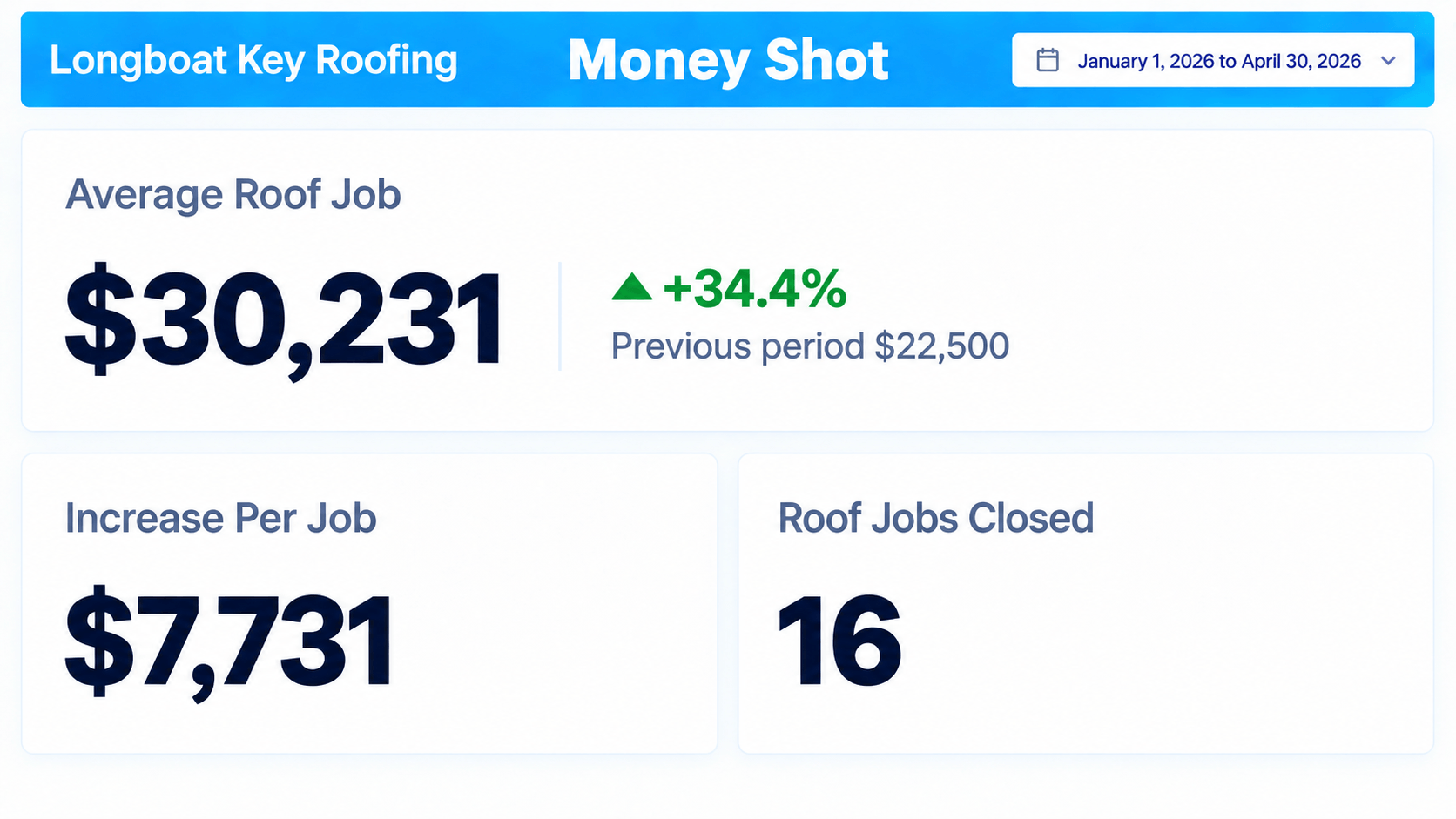
During the first 120 days of 2026, Longboat Key Roofing:
- Closed 16 tracked roofing jobs.
- Increased its average roof job value by 34.4%, from $22,500 to $30,231.
- Generated approximately $483,696 in tracked roofing revenue.
Those figures include the closed projects tracked through marketing channels we managed or supported, not every job the company completed.
Now, does that prove they outranked every larger roofing company in those markets?
No. And that’s not the point.
They didn’t need to become the biggest roofing company in Florida. They needed to become a stronger choice for homeowners in the communities they wanted to serve.
That’s what focusing on the right markets, communicating your strengths, and building on your existing reputation can accomplish.
Read the full Longboat Key Roofing case study: 34% increase in average roof job value in 120 days.
When Should You Expand to Another City or Service?
Not just because your keyword rankings improved.
That’s ONE measurement.
Before expanding, look at whether your original market is producing meaningful business:
- Are you receiving more qualified calls and estimate requests?
- Are those inquiries coming from the city or service you’re targeting?
- Are you booking more inspections?
- Are those appointments turning into profitable roofing jobs?
- Do you have the crews, equipment, and scheduling capacity to handle additional work?
If South Elgin is producing profitable jobs consistently, maybe Elgin or St. Charles is next.
Or perhaps your residential replacement business is strong enough that you want to start building a larger market share in metal roofing.
Expand because you’re building a successful business, not because you want a longer list of keywords in your ranking report.
Your Biggest Competitive Advantage Might Have Nothing to Do With SEO
Let’s say your biggest competitor is a large corporate or private equity-owned roofing company.
You’ve got eight employees, and your business is family-owned and operated.
USE THAT TO YOUR ADVANTAGE!
People buy from people.
Small businesses buy from small businesses.
A lot of property owners would rather work with someone local, someone they recognize from the community, or someone who personally stands behind the work.
That doesn’t mean every large roofing company provides poor service, or every family-owned business provides excellent service.
It means you have an opportunity to build a different type of connection.
And you should be using it.
Show the People Behind Your Roofing Company
Instead of filling your website and social media with generic claims about quality and customer service, introduce the people who actually make your business work.
Show the owner.
Show the person answering the phone.
Show the salesperson meeting a property owner for an estimate.
Show your crew installing a roof, explaining a problem, or cleaning up after a project.
If your family has been involved in the business for years, tell that story.
If your lead installer has spent 25 years working with metal roofing systems, let people know.
These are things a potential customer can relate to.
You’re not selling a roof to an algorithm. You’re trying to earn somebody’s trust.
And when that customer has three estimates sitting on the kitchen table, knowing who they’re dealing with can make a difference.
The larger competitor might still outrank you.
They might still have more reviews.
But if the property owner knows who you are, recognizes your crew, trusts your experience, and feels comfortable working with you, you’ve given them reasons to choose your company that go beyond rankings.
For more on turning that trust into actual inquiries and appointments, see our guide to roofing website conversion and turning traffic into roof jobs.
Does AI Search Make It Easier or Harder for Smaller Roofing Companies to Compete?
Now here’s where things get interesting.
Property owners aren’t just typing “roofing company near me” into Google anymore.
They’re asking more detailed questions.
For example:
“Who’s a good metal roofing contractor near South Elgin with experience working on older homes?”
Or:
“Can you recommend a commercial roofing company that can replace a flat roof on an occupied warehouse without interrupting deliveries?”
Those are very different searches from someone typing “roofer.”
And that’s where a smaller company that specializes in a particular service or type of project has an opportunity.
Think of AI recommendations the same way you would think about recommending a roofing contractor to your best friend.
If your friend asks for a roofer, you’re probably not going to recommend some random business you know nothing about.
Because if that contractor screws up the job, guess who’s going to hear about it?
YOU!
Google and AI search platforms have a similar challenge. They need to provide relevant, useful information in response to what people are asking.
That doesn’t mean ChatGPT and Google use identical systems or that anyone knows every factor behind their recommendations.
But from a practical marketing standpoint, your goal is pretty straightforward:
Make it easier for people and search platforms to find credible information about the roofing work your company actually performs.
Stop Telling Google You’re an Expert. SHOW THEM!
Anybody can put “experienced roofing contractor” on a website.
Anybody can claim to specialize in metal roofing, flat roofs, or commercial roof replacement.
- What have you actually done?
- And where can somebody see it?
That’s where your past roofing projects become valuable marketing assets.
Let’s say you’ve replaced several metal roofs on older homes around Kane County.
Don’t just upload a few pictures to Facebook with a caption that says, “Another happy customer!”
Tell people what they’re looking at.
- What city was the project in?
- What roofing system did you install?
- What was wrong with the previous roof?
- What made the job challenging?
- How did your crew handle those challenges?
- What did the finished roof look like?
You don’t need to write a novel about every project.
But give people enough information to understand what you did and why it matters.
A page saying “We specialize in metal roofing” is a claim. A real metal roofing project with photos, location, materials, and details gives people something to evaluate.
And when a potential customer asks AI about a contractor experienced with that kind of project, you’re making relevant information about your company available.
That doesn’t guarantee an AI recommendation.
It gives your company a better opportunity to be understood and considered.
Commercial Roofers Have an Opportunity Here, Too
Let’s say a property manager needs a flat roof replaced on a busy distribution center.
Trucks are coming and going all day.
There are scheduled deliveries, employees working inside, tenants or customers to consider, and equipment that needs to stay accessible.
They can’t just shut the business down for a week because the roofing crew showed up.
Now, if you’ve handled a project like that, why wouldn’t you talk about it?
Show how you coordinated with the facility manager.
Explain how your team managed equipment access, deliveries, and work areas.
Describe how the project was planned to minimize disruption while protecting people and property.
Show the roofing system and the completed work.
Those details tell a commercial property owner something a generic “We install TPO roofing” page doesn’t.
They show you understand the challenges of working on an operating commercial property.
That’s the kind of experience that can separate you from a competitor, regardless of how many trucks they own.
Can a Smaller Roofer With 65 Google Reviews Beat One With 200?
Absolutely possible.
But let’s be clear: having fewer reviews isn’t an advantage by itself.
Reviews are important for visibility and trust. Google explicitly identifies review count and positive ratings among the factors that can contribute to local prominence.
So yes, a roofing company with 200 strong reviews may have an advantage over a company with 65.
But that doesn’t mean the competition is over.
Maybe your competitor has been collecting reviews for 30 years, and you’ve only been in business for five.
Okay, so what?
Keep getting them.
And don’t just concentrate on the total number.
Pay Attention to What Customers Actually Say
Think about what property owners want to know before hiring a roofing company.
- Did the crew show up when promised?
- Did the company communicate throughout the project?
- Was the final cost consistent with what was explained?
- Did they protect the landscaping?
- Did they clean up afterward?
- Did the roofing company finish when it said it would?
Those are the details people look for when they’re trying to decide who to trust.
A review that describes a real roof replacement and the customer’s experience provides a lot more useful information than a generic “Great company!”
Of course, you can’t dictate what customers write. Nor should you.
But you can consistently ask real customers for honest feedback after completing a job.
And when they mention something specific, acknowledge it in your response.
For example, if a customer says your crew worked around the delivery schedule at their commercial property and kept the work area organized, your reply should recognize those details rather than simply saying, “Thanks for the five stars!”
You’re showing future customers that you listened and that those details matter to your business.
You can learn more about this approach in our AI SEO Secret Formula for Roofers.
Stop Watching Your Competitor’s Review Count Every Day
Here’s something else.
If your competitor has 200 reviews and you have 65, you don’t need to obsess over the difference every morning.
You need a system for consistently asking customers for reviews.
If you’re completing roofing jobs every week but only asking for reviews once in a while, that’s a business process you can improve.
Maybe your competitor slows down. Maybe they don’t.
Either way, you’re building your own reputation.
And that’s something you control.
What Should a Smaller Roofing Company Do Over the Next 90 Days?
If you’re competing against larger, established roofing companies, here’s where I’d concentrate your efforts.
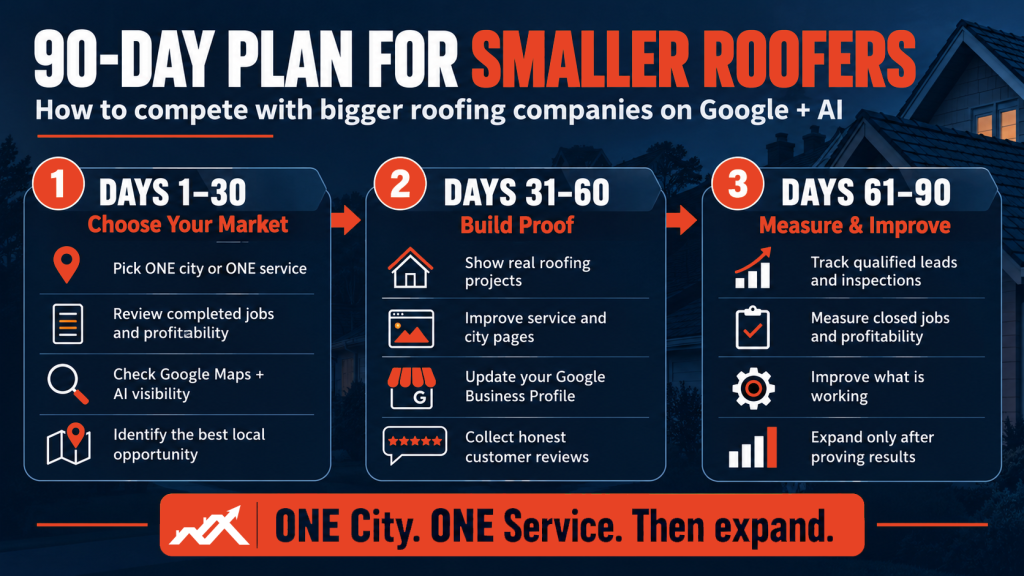
First 30 Days: Pick Your Market and Find the Gaps
Choose ONE service or ONE geographic area where you have a realistic opportunity to gain more business.
Look at your actual sales history.
- Which types of roofing jobs are most profitable?
- Where are you already completing work?
- Which services do you have the strongest experience, equipment, and crews to handle?
Then evaluate your current visibility.
Search Google Maps for the service and city.
Look at your organic search performance.
Check how your company appears when somebody asks ChatGPT or Google’s AI for a contractor that handles the work you’re targeting.
Don’t rely on one AI answer as a definitive ranking report. Recommendations can vary by question and context.
You’re looking for gaps between what your company can actually do and what customers can find out about it online.
Days 31–60: Build Evidence Around That Service or Area
Now start showing your work.
Identify three to five real projects related to the market you want to win.
Create useful project pages or case studies, where warranted, that explain what you did.
Use original photos and videos.
Introduce relevant members of your crew.
Improve your main service page and the internal links supporting it.
Make sure your Google Business Profile accurately represents the services you offer.
And keep asking customers for honest reviews.
The goal is not to publish the most content. It’s to publish the information that helps property owners understand why you’re qualified to do their job.
If you want a broader framework for improving your presence across Google, Maps, and AI search, read our guide on how property owners choose roofing companies in 2026.
Days 61–90: Measure Jobs, Not Just Rankings
At this point, start looking at what your marketing is actually producing.
- Are you getting more calls from the city you’re targeting?
- Are more people asking about the specific roofing service you’re promoting?
- Are those calls becoming inspections?
- How many estimates are you sending?
- How many jobs are closing?
- And most importantly, are those jobs profitable?
You might find that you’re getting fewer calls than one of your competitors but winning a higher percentage of the jobs you actually want.
That’s not necessarily a problem.
I’d rather have 10 qualified opportunities for profitable metal roof replacements than 50 calls for work my crew doesn’t even want to take.
Keep improving what works.
Once you’ve built a strong position in that market and can support the additional workload, start considering the next service or city.
Then repeat the process.
Don’t Confuse Being Bigger With Being Better
A roofing company that’s been around for 30 years has probably earned some real advantages.
Maybe it has more reviews, stronger brand recognition, more employees, and a larger marketing budget.
You can’t pretend those advantages don’t exist.
But you don’t have to compete with all of them at once.
You can concentrate on a particular type of work, a particular market, and the customers you serve best.
You can show actual projects instead of relying on generic claims.
You can introduce the people behind your company.
You can keep building your reputation and make it easier for customers to see exactly what you’re capable of.
And you can use Google and AI search as additional ways to help the right customers discover that information.
As I said in the video:
“You don’t need to beat them everywhere. Start with one service or one area, build your reputation, show people what you’re capable of, and then expand.”
You don’t have to be the biggest roofing company. You just have to give people a better reason to choose YOU.
Key Takeaways: How Smaller Roofers Can Compete and Win
- Pick ONE battle you can win. Start with your business location, then evaluate neighboring cities based on property values, building inventory, property age, and potential roofing demand. Give additional consideration to cities where you’ve already completed projects. Build your market share before expanding.
- Turn ONE roofing project into more opportunities. A completed job can give you recognizable work in a neighborhood, an opportunity to earn an honest customer review, potential referrals, and a reason to canvass surrounding properties. Don’t overlook the marketing value of work you’ve already completed.
- Being family-owned or locally operated can be an advantage. Show the owner, employees, experienced crew members, and people customers will actually work with. Give property owners a reason to trust YOU instead of automatically choosing the biggest name.
- Don’t just claim experience. SHOW IT! Publish real roofing projects with locations, roofing systems, photos, challenges, and solutions. This gives potential customers useful information and helps search platforms understand the work your company performs.
- AI search creates opportunities, not guarantees. When someone asks for a roofer experienced with a specific type of project, a smaller specialist may be a better fit than a larger general contractor. Make sure your website demonstrates that experience.
- Keep building your Google reviews. You might have 65 reviews while your competitor has 200. Continue collecting honest customer feedback and responding thoughtfully. Don’t get so caught up watching competitors that you neglect your own progress.
- Measure customers and revenue, not just rankings. More visibility is valuable when it produces qualified inquiries, booked inspections, profitable roofing jobs, and sustainable growth.
The goal isn’t to beat your biggest competitor everywhere. It’s to become a stronger choice for the customers and projects you actually want, then expand from there.
Frequently Asked Questions
Can a small roofing company outrank a larger competitor on Google?
Yes. A smaller roofing company can outrank a larger competitor for relevant searches, particularly when it has a strong website, useful service-specific content, and demonstrated experience in the market being searched. However, Google rankings aren’t determined by company size or marketing budget alone. Local results also consider relevance, distance, and prominence. A smaller roofer can improve its competitive position by concentrating its marketing resources on a specific service or geographic area rather than trying to compete everywhere.
How can a new roofing company compete with an established roofer that has hundreds of Google reviews?
Start by choosing a market where you can realistically compete, consistently earning honest customer reviews, and showing examples of completed roofing projects. Make your website and Google Business Profile useful to potential customers. You don’t have to match a competitor’s total review count before you can win customers, but you do need to build credibility. Focus on the quality of your work, customer experience, and consistent marketing rather than expecting one tactic to overcome years of established visibility.
Does having more Google reviews automatically make a roofing company rank higher?
No. Review count and positive ratings can contribute to local prominence, but Google also considers relevance and distance. A company with more reviews won’t automatically rank first for every roofing search. Smaller companies should continue collecting genuine reviews, maintaining accurate business information, improving their website, and showing their experience in the services and markets they want to attract.
Can a small roofing company appear in ChatGPT or Google AI recommendations?
Yes. AI search platforms can recommend smaller roofing companies, but there is no guaranteed formula for being selected. A useful starting point is to make your services, locations, experience, and completed projects easy to find and understand online. For example, a roofing company with documented experience replacing metal roofs on older homes may be relevant when someone specifically requests a contractor with that experience. Recommendations can vary depending on the platform, question, location, and information available.
Should a roofing company focus on one city or offer services throughout an entire region?
That depends on your business, available crews, profitability, and existing market position. A smaller roofing company with limited marketing resources may benefit from focusing on one city or one specialized service before expanding. A commercial roofer that regularly handles large industrial projects across multiple cities may be better served by focusing on a particular roofing system or building type instead. The important thing is to concentrate your marketing on profitable opportunities rather than spreading your resources across too many markets.
How can a completed roofing project help a company get more jobs in the same neighborhood?
A completed roofing project provides a visible example of your work that nearby property owners may recognize. With the customer’s permission, you can feature the project on your website and social media, request an honest review, ask for referrals, and canvass nearby properties. One completed project can create multiple opportunities to introduce your company to potential customers in that neighborhood.
How long does it take a small roofing company to compete with established competitors in Google Search and Maps?
There is no fixed timeline. Results depend on competition, your starting visibility, business location, website quality, Google Business Profile, reputation, and ongoing marketing efforts. A 90-day plan is useful for establishing priorities, improving content, documenting projects, and measuring progress, but it shouldn’t be treated as a promise of first-page rankings. Track improvements in qualified inquiries, booked inspections, closed jobs, and profitability alongside search visibility.
Are You Trying to Compete With Bigger Roofing Companies?
You don’t need their marketing budget. You need a strategy that makes the most of yours.
At Roofing REV Marketing, we help roofing companies identify the right services and markets to target, improve their visibility on Google and AI search, and turn that visibility into qualified leads and profitable roofing jobs.
Let’s find out where your roofing company has the best opportunity to compete and grow.
Google’s AI Is Calling Roofing Companies: Here’s How to Respond
Google's AI is no longer just helping property owners find roofing companies. It's now making phone calls on their behalf, asking questions about services, pricing, and availability. One of our roofing clients recently received one of these calls, and it revealed a...
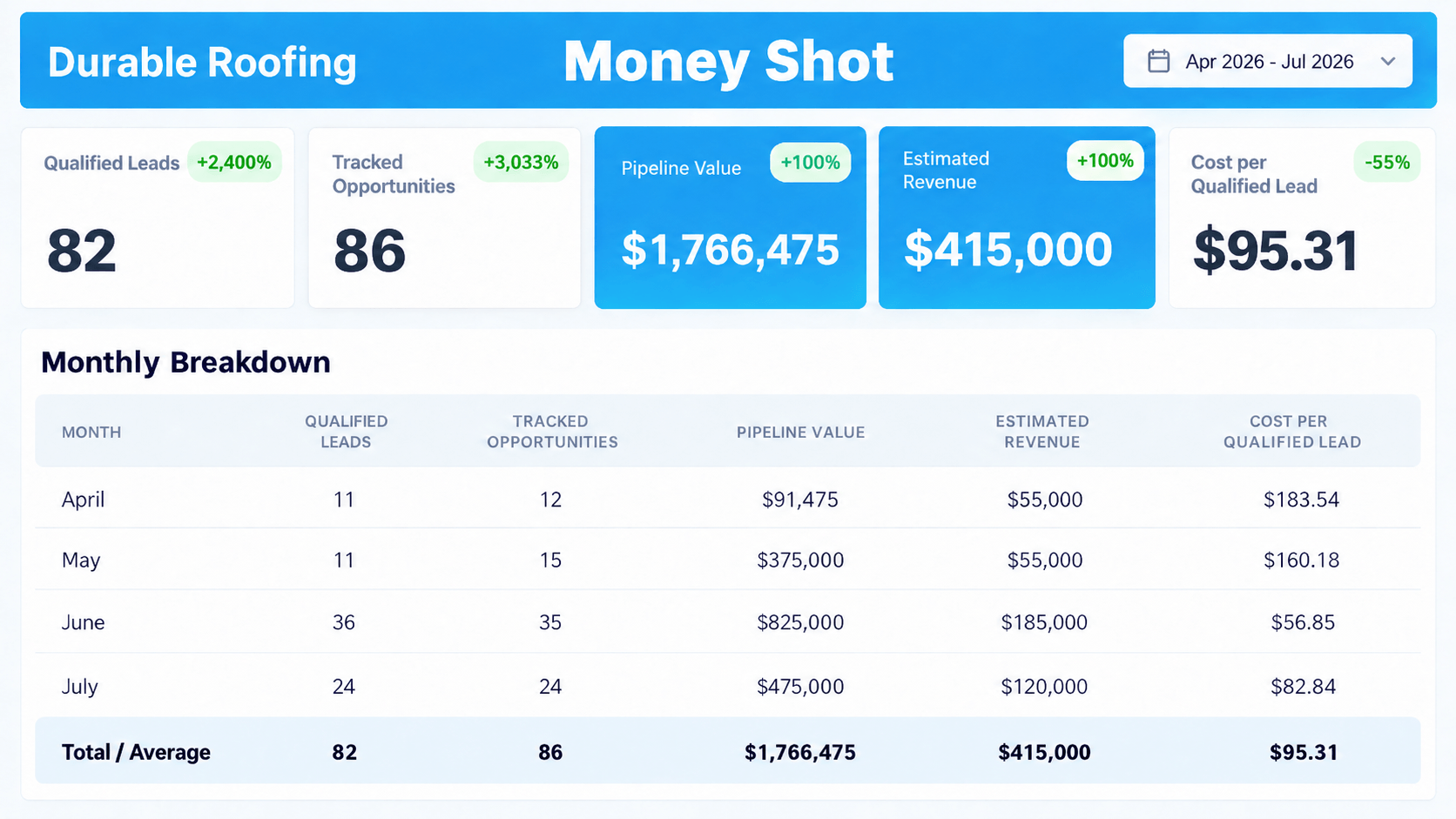
Durable Roofing Generated 82 Qualified Leads Within First 4 Months
Durable Roofing Generated 82 Qualified Leads Within First 4 Months That’s $1.77 Million in Pipeline Value!View More Success Stories > Durable Roofing Generated 82 Qualified Leads Within First 4 MonthsDurable Roofing is a fourth-generation roofing company with more...
Longboat Key Roofing Increased Average Job Value 34% In 120 Days
Longboat Key Roofing Increased Average Job Value 34% In 120 Days While Expanding Beyond a Slowing Referral MarketView More Success Stories > Longboat Key Roofing Increased Average Job Value 34% In 120 DaysLongboat Key Roofing had built much of its business through...