
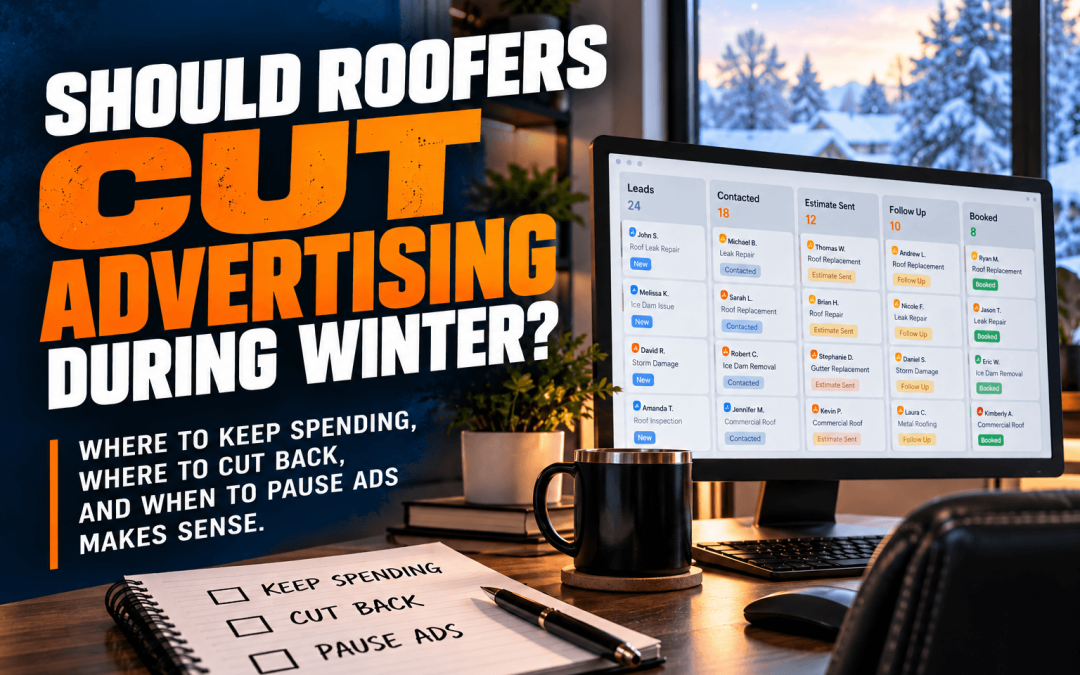
Should roofing companies cut their advertising during the slower winter months?
Our answer is generally NO. But that doesn’t mean you should keep spending the same amount of money, advertising the same services, or targeting the same customers.
I’m Chris Taglia, and my brother Carm Taglia and I recently discussed this in our first episode of Two Brothers, One Opinion.
We agree that roofing companies should continue marketing during winter. But we also played devil’s advocate because there ARE situations where paying for advertising during the slow season makes absolutely no sense.
The real question isn’t simply whether you should cut your roofing advertising budget.
It’s where you should keep spending, where you should cut back, and when stopping paid advertising is actually the smarter business decision.
And there’s a BIG difference between cutting advertising and stopping marketing altogether.
The Roofing Leads You Generate in Winter Could Become Your Spring Jobs
One reason I recommend keeping your marketing going is that the leads you’re generating today could become your roofing jobs in the spring.
Think about how people actually buy a roof.
Some property owners have an active leak and need help immediately. Others know their roof is getting older, but they’re trying to squeeze another year out of it.
Maybe they’re saving money. Maybe they’re traveling for the holidays. Maybe they don’t want to deal with a roof replacement until the weather improves.
That doesn’t mean they’ve forgotten about the problem.
And some of those issues they’re putting off today might not make it through winter.
A small leak in November could turn into a bigger problem when snow, ice, freezing temperatures, and moisture enter the picture.
The customer who wasn’t ready to move forward three months ago might suddenly need a roofing contractor NOW.
Are they going to remember your company, or are they going to start searching for someone else?
That’s why I recommend staying visible, maintaining your branding, and keeping in touch with potential customers.
You want to be one of the first roofing companies they think about when they’re finally ready to make a decision.
Stop Advertising the Wrong Roofing Services, Not Necessarily All Services
Here’s where I would change my approach during winter.
I wouldn’t keep throwing money at the exact same advertising campaigns I was running in June or July, especially if I were a residential roofer in the Midwest.
I’d start looking at what people actually need during the colder months.
Cold-Weather Roofers Should Focus on Customers Who Need Help NOW
If you’re operating in Illinois, Wisconsin, Iowa, or another cold-weather market, I’d put more attention on services like:
- Active roof leak repair
- Emergency roofing repairs
- Ice dam problems
- Missing shingles or storm damage
- Roof evaluations when conditions allow
These are customers who may have a problem they can’t wait until spring to address.
Compare that with somebody considering a complete shingle roof replacement but who doesn’t want construction happening around Thanksgiving or Christmas.
They’re at a completely different stage of the buying process.
One person needs help immediately. The other is planning something for the future.
Both can become customers, but they shouldn’t necessarily get the same advertising message or the same amount of your budget.
If your goal is to get money coming through the door during winter, I’d concentrate on the problems people need solved right now.
Warm-Weather Roofing Markets Are Different
Now, if you’re in Florida, Arizona, or another warmer market, your winter advertising strategy could look completely different.
You may still have property owners ready to replace their roofs in November, December, or January.
The weather might allow your crews to keep installing while roofers in Wisconsin are dealing with snow and ice.
Of course, the holidays still affect scheduling and buying decisions.
Nobody’s necessarily excited about having their roof torn off while they’re serving Thanksgiving dinner.
But the point is that you shouldn’t take a winter advertising strategy that works in Illinois and automatically apply it to Florida.
Your advertising should follow your local demand, weather conditions, available services, and business goals. Not just the calendar.
Where Should Roofers Spend Their Advertising Budget During Winter?
This is where you need to understand the difference between someone looking for a roofer NOW and someone who might need one six months from now.
Google Ads: Target Specific Roofing Problems
If you’re trying to generate immediate winter revenue, Google Search Ads can make sense because you’re reaching people actively searching for a solution.
For example:
- Roof leak repair near me
- Emergency roof repair
- Roof repair in [City]
- Ice dam removal near me
Those searches suggest a more immediate need than someone casually researching different shingle colors.
But don’t just keep running your normal campaigns and hope for the best.
Look at the actual search terms triggering your ads.
Are people searching for services you can perform? Are they in cities you want to work in? Are they turning into booked appointments and paying customers?
Google’s Search Terms report can help identify searches that are wasting money. You can use that information to refine your keywords and exclude irrelevant searches.
Let’s say you’re a roofer in northern Illinois and your budget is limited.
Why spread that money across roof replacements, metal roofing, gutters, siding, repairs, and 15 different cities if most of your winter revenue is coming from roof leaks in three nearby communities?
Focus your money on the customers and services that give you the best chance of actually booking profitable work.
Google Local Services Ads: Advertise When You Can Answer and Deliver
Google Local Services Ads can also be worth keeping active for relevant winter roofing services.
But you need to manage them.
Make sure your advertised job types match the work you’re actually performing.
Check your service areas, business hours, budget, and lead quality.
And remember that LSAs don’t work exactly like Google Search Ads. Your weekly budget is a spending limit, not a fixed amount you automatically pay.
Simply lowering that limit isn’t necessarily the best way to manage winter demand. You need to understand how roofing LSA budgets actually work before deciding what to change.
If you’re unavailable to take new jobs, pausing your ads may make more sense than paying for leads you can’t handle.
If you aren’t sure where your budget belongs, we’ve also broken down Google Local Services Ads versus Google Ads for roofers.
The larger point is to make sure your advertising matches your actual availability and the kind of work you want.
Facebook and Instagram Ads: Maybe Cut Back on Immediate Replacement Campaigns
During our conversation, I mentioned that I’d probably reduce broad roof replacement advertising on Facebook during winter in colder markets.
That doesn’t mean Facebook advertising can’t work.
It means you need to understand who you’re trying to reach.
Someone scrolling Facebook might not be actively looking for a roof replacement right now.
But they could be starting to think about one.
Maybe they’re exploring financing. Maybe they’re researching roofing materials. Maybe they’re considering a spring project.
Those are potential future customers.
If your goal is building a spring pipeline, advertising to that audience could make sense.
But if your crews need roofing jobs this week, I’d rather concentrate my limited advertising budget on people actively searching for roof repairs.
See the difference?
One strategy is designed to generate immediate opportunities. The other helps develop customers who may buy later.
Both can have value. Just don’t confuse the two.
Where to Keep Spending, Cut Back, or Pause
| Your situation | What we’d consider |
|---|---|
| Active leaks and repairs are producing profitable jobs | Keep advertising those services |
| Full replacements are generating interest but few immediate bookings | Reduce broad campaigns or shift messaging toward spring planning |
| Google Ads are attracting irrelevant searches or distant customers | Tighten keywords, locations, and targeting |
| Your CRM contains estimates and leads that were never followed up | Put more effort into reactivation before buying additional leads |
| Your crews are unavailable and nobody can handle incoming inquiries | Pause paid lead generation until you can respond and deliver |
| You’re building your spring schedule | Continue appropriate marketing and follow-up, even if immediate lead generation slows |
None of this is automatic.
If a campaign is producing profitable jobs, I wouldn’t shut it off simply because it’s January.
And if a campaign is losing money, I wouldn’t keep funding it just because somebody says you should never stop advertising.
Your Next Roofing Job Might Already Be Sitting in Your CRM
This is something Carm brought up during our conversation, and I think it’s one of the biggest opportunities roofing companies overlook.
Everybody’s trying to generate MORE leads.
More Google Ads. More Facebook Ads. More calls. More website inquiries.
But what about all the people you’ve already talked to?
What about the estimates you sent six months ago?
What about that customer who said they’d call you after the holidays?
Or the commercial property manager who was waiting for a budget approval and never followed up?
You already paid to generate those opportunities. Why aren’t you doing something with them?
Start With the Estimates That Never Closed
Open your CRM and start looking at:
- Estimates sent but never approved
- Customers who postponed roof repairs
- Roof replacements delayed until spring
- People who requested information but never scheduled
- Commercial projects that stalled during planning or approvals
Before you send everyone the same generic email, look at WHY they didn’t move forward.
- Was it money?
- Were they waiting for another estimate?
- Did they simply decide to put it off until spring?
- Maybe you never followed up at all.
And yes, sometimes people just ghost you.
That doesn’t automatically mean they’re a lost cause.
Talk to Customers Based on Why They Delayed
Let’s say you quoted a roof replacement in August, but the property owner wanted to get another winter out of the existing roof.
You don’t necessarily need to call them offering a discount.
You could simply ask:
“Hey, we gave you an estimate a few months ago. Just checking in. Did you end up getting that roof taken care of, or are you still planning to do something in the spring?”
That’s a normal conversation.
If they still need the work, you have an opportunity to schedule an evaluation, review their estimate, or start planning for spring.
For commercial roofing, the conversation could be completely different.
Maybe the project was delayed because the building owner hadn’t approved the budget.
Maybe the property manager was coordinating with tenants.
Maybe a distribution center couldn’t interrupt operations during its busy shipping season.
Winter might be the right time to revisit scheduling, access requirements, budgets, and project planning.
Not every roofing job needs a new lead. Sometimes it needs better follow-up.
And if your business is slower during winter, you finally have time to work through those opportunities instead of letting them sit in your CRM collecting dust.
The Cost of Inaction: Why Roof Repairs Can Get More Expensive
Another opportunity is educating customers about what can happen when they keep putting off roofing problems.
Let’s say somebody has a roof leak that could be repaired for $700.
They know about it, but they don’t want to spend the money right now.
So they decide to wait.
Then winter comes.
More water gets into the attic. Insulation gets wet. Now there’s a ceiling stain. Maybe some drywall needs to be repaired and painted.
If moisture problems continue, there could even be mold to deal with.
What started as a $700 roofing repair could become a much more expensive project.
That’s an example, not a prediction of what every leak will cost.
But the underlying problem is real. Winter moisture and ice dams can contribute to roof leaks and interior damage.
The point isn’t to scare customers into buying something they don’t need.
It’s to help them understand the cost of doing nothing.
And this applies to marketing your roofing company, too.
If you stop reaching customers, stop following up, and stop improving your business for three or four months, what’s the cost of that inactivity?
If You’re Not in the Conversation, You’re Not Even on the Field
Carm brought up a football analogy during our conversation that I think explains this pretty well.
If you’re not on the field, you’re not even there to compete.
Let’s say somebody needs a roof repair in January.
They search Google. They check the Map Pack. Maybe they ask ChatGPT or another AI search platform for roofing company recommendations.
Then they compare a few contractors, read reviews, look at pictures, and make some phone calls.
Are you going to be one of those companies they consider?
I always like to compare a few companies before making a big purchasing decision.
Your roofing customers are doing the same thing.
They’re checking websites. They’re looking at reviews. They’re talking to different contractors.
And they may not make a decision the first time they see your company.
That’s why staying visible matters.
Your name, your logo, your projects, your reviews, and your previous conversations help customers recognize your business when they’re ready to move forward.
Now, that doesn’t mean Google will punish your organic rankings because you stopped spending on ads.
It won’t.
Google has specifically explained that buying advertising doesn’t improve your organic search rankings.
But if your ads stop running, those paid placements stop bringing you traffic. And if you also stop creating content, asking for reviews, following up with customers, and showing your work, you’re creating fewer opportunities for people to discover and remember your company.
There’s a difference.
You don’t need to be everywhere all the time.
But you do need to give the right customers opportunities to find you and choose you.
When DOES It Make Sense for a Roofer to Stop Paying for Advertising?
Now let’s play devil’s advocate.
Because there are absolutely situations where we’d recommend cutting or temporarily stopping your paid advertising
You’re a One-Crew Roofer Taking the Winter Off
Let’s say you’re a smaller roofing company.
You have one crew. Winter comes around, your crew takes a month off, and you decide to head somewhere warm yourself.
Nothing wrong with that.
But who’s answering the phone?
Who’s going out to look at the roof?
Who’s doing the work?
If the answer is nobody, why are you spending $100, $200, or even $400 to generate a lead you can’t do anything with?
You’re paying for a potential customer, and then you’re giving that customer a reason to call somebody else.
That makes no sense.
You Can’t Answer Calls or Follow Up With Leads
Even if your crews are working, you have another problem if nobody’s answering the phone.
Think about it.
You spend money getting someone interested enough to call your roofing company.
They have a leak. They’re looking for help. They call.
Nobody answers.
They leave a voicemail.
Then they call the next roofing company.
What did your advertising budget accomplish?
Before you spend more money buying leads, make sure you have a way to answer calls, schedule appointments, and follow up.
If you’re relying on LSAs, this is particularly important. We’ve covered why roofing Local Services Ads stop producing leads and what to fix, including missed calls and poor lead management.
Sometimes improving your lead handling will do more for your revenue than increasing your advertising budget.
Your Advertising Is Bringing in Jobs You Can’t Perform
Maybe you’re advertising full roof replacements in a market where weather conditions prevent your crews from doing that work.
Or your campaign is generating requests for services you don’t offer during winter.
You need to decide whether those customers are worth nurturing for spring or whether the advertising money would be better spent elsewhere.
The answer depends on your business.
But don’t keep spending money simply because the campaigns were running during the summer.
If you can’t service the customer, and you don’t have a system to book or nurture the opportunity, reconsider why you’re paying for that lead.
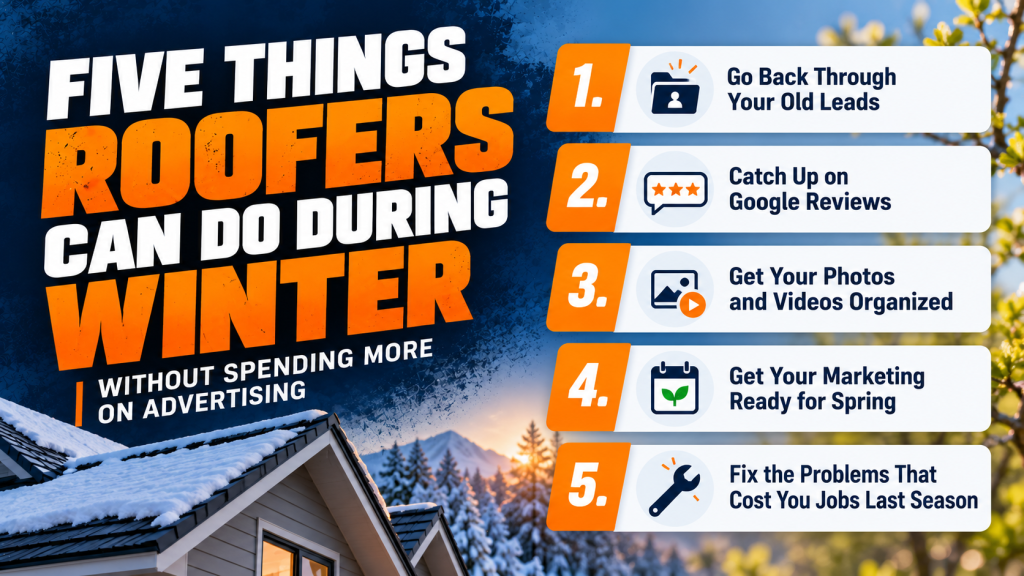
Five Things Roofers Can Do During Winter Without Spending More on Advertising
One point Carm and I both agree on is that even if you reduce paid advertising, there’s still plenty you can do to market your business.
You don’t always need to hire a marketing company or spend more money to make progress.
Especially if you’re just starting out.
Winter can be a great time to work ON your business because you’re not running around like a chicken with its head cut off trying to manage ten different roofing jobs.
1. Go Back Through Your Old Leads
You’ve already paid for those leads.
Follow up with the people who never scheduled, the estimates that never closed, and customers who put their projects on hold.
You might be surprised at how much opportunity is already sitting there.
2. Catch Up on Google Reviews
Remember all those jobs you completed during the busy season?
Did you ask those customers for a review?
If not, and they’re legitimate customers you haven’t asked yet, now’s a good time to reconnect.
You don’t need a new roofing project to ask a past customer about their experience.
And don’t just focus on collecting stars. Pay attention to what customers say about your workmanship, communication, and overall service.
3. Get Your Photos and Videos Organized
I know roofing companies that have hundreds of project pictures sitting on their phones.
Beautiful finished roofs. Before-and-after pictures. Crew videos. Drone footage.
And nobody ever does anything with them.
Get those pictures organized.
Sort them by project, city, service, and roof type.
Start uploading useful content to your website, YouTube, Google Business Profile, and social media.
Show people what you’ve actually done instead of just telling them you’re an experienced roofer.
4. Get Your Marketing Ready for Spring
Maybe you’ve been putting off updating your website.
Maybe you need better service pages, stronger project examples, or a plan for the cities you want to target next year.
Winter gives you time to get that work done.
Then, when spring arrives, you’re not trying to build everything while your phone is ringing and your crews are already booked.
There are plenty of other slow-season marketing strategies for roofers that can help keep your company visible without relying entirely on paid advertising.
5. Fix the Problems That Cost You Jobs Last Season
Go back and look at what happened during your busy months.
- How many calls did you miss?
- How many estimates never received a follow-up?
- How many appointments turned into actual roofing jobs?
- Did one salesperson close substantially more work than another?
- Were you buying leads for services or areas that weren’t profitable?
These aren’t always advertising problems.
Sometimes they’re sales, customer service, follow-up, or operational problems.
And if you’re not fixing those issues, spending more money on advertising might just make the problems more expensive.
Don’t Judge Your Winter Advertising by Leads Alone
Here’s something I’d add to the conversation.
Let’s say your roofing advertising generated 40 leads in July and only 15 in January.
Does that automatically mean January was a bad month?
Not necessarily.
What if those 15 leads produced eight booked appointments and six profitable repair jobs?
Now compare that with 40 leads that produced only a few appointments and one sold job.
Which campaign would you rather have?
The answer should depend on the revenue and profitability of the work, not just the number of leads.
When reviewing your winter advertising, pay attention to:
- Cost per qualified lead: What are you paying for inquiries that actually fit your services and market?
- Cost per booked appointment: How much does it cost to get a real opportunity onto the calendar?
- Customer acquisition cost: How much are you spending to acquire an actual customer?
- Revenue and profitability: Are those customers producing work worth pursuing?
You might discover that your winter advertising deserves a smaller budget, a different service focus, or even more investment in a campaign that’s working.
But make that decision based on results, not assumptions about winter.
Frequently Asked Questions About Winter Roofing Advertising
Should roofing companies lower their advertising budgets during winter?
Are Google Ads or Facebook Ads better for roofers during winter?
Should roofers pause Local Services Ads when their crews aren't available?
Can a roofing company generate leads during winter without paying for advertising?
So, Should Roofers Cut Advertising During Winter?
Not automatically.
Carm and I both believe roofing companies should keep marketing through the slower months.
But that doesn’t mean every company should keep spending the same amount on paid advertising.
If you’re in a cold-weather market, you might shift more money toward active roof repairs and emergency services instead of broad replacement campaigns.
If you’re in a warmer market, roof replacements may still be worth advertising.
If you already have hundreds of old leads and estimates sitting in your CRM, maybe your next opportunity isn’t buying more leads. Maybe it’s doing a better job following up with the ones you already have.
And if you’re a one-crew roofer taking the winter off with nobody available to answer the phone or do the work, then yes, temporarily stopping paid advertising could be the smartest decision.
The goal isn’t to keep spending money. The goal is to keep your business moving forward.
Because winter is also your opportunity to get everything ready for spring.
While some roofers are waiting for the phone to start ringing again, you could be following up with customers, building your brand, booking future projects, improving your sales process, and getting your marketing in order.
You don’t need every hit to be a home run.
Sometimes it’s the smaller things you do consistently that put runs on the board.
Turn Your Slow Season Into a Winter-to-Spring Revenue Plan
Want to take this a step further?
We created The Winter-to-Spring Roofing Revenue Engine™ to help roofing companies generate revenue during the slower winter months AND build a stronger pipeline for spring.
This isn’t another generic marketing checklist. It’s a step-by-step training system covering winter advertising, reactivating old leads, improving Google visibility, sales follow-up, and getting roofing projects booked before spring arrives.
Inside, you’ll learn how to:
- Generate winter revenue by focusing on services customers actually need.
- Reactivate old estimates and leads already sitting in your CRM.
- Adjust advertising and Google visibility strategies for winter.
- Improve sales conversations, follow-up, and appointment booking.
- Start booking spring roofing projects before the busy season.
- Build a year-round marketing plan aligned with your revenue goals.
We’ve also included 15 worksheets to help you put what you’ve learned into action.
Winter doesn’t have to mean sitting around waiting for the phone to ring. Use that time to generate revenue NOW and get your business ready for spring.
About the Hosts
Chris Taglia and Carm Taglia are brothers and business partners at Roofing REV Marketing, where they help roofing companies connect marketing, sales, and follow-up to booked jobs and revenue. Two Brothers, One Opinion brings their real-world marketing experience and perspectives to questions roofing business owners face.

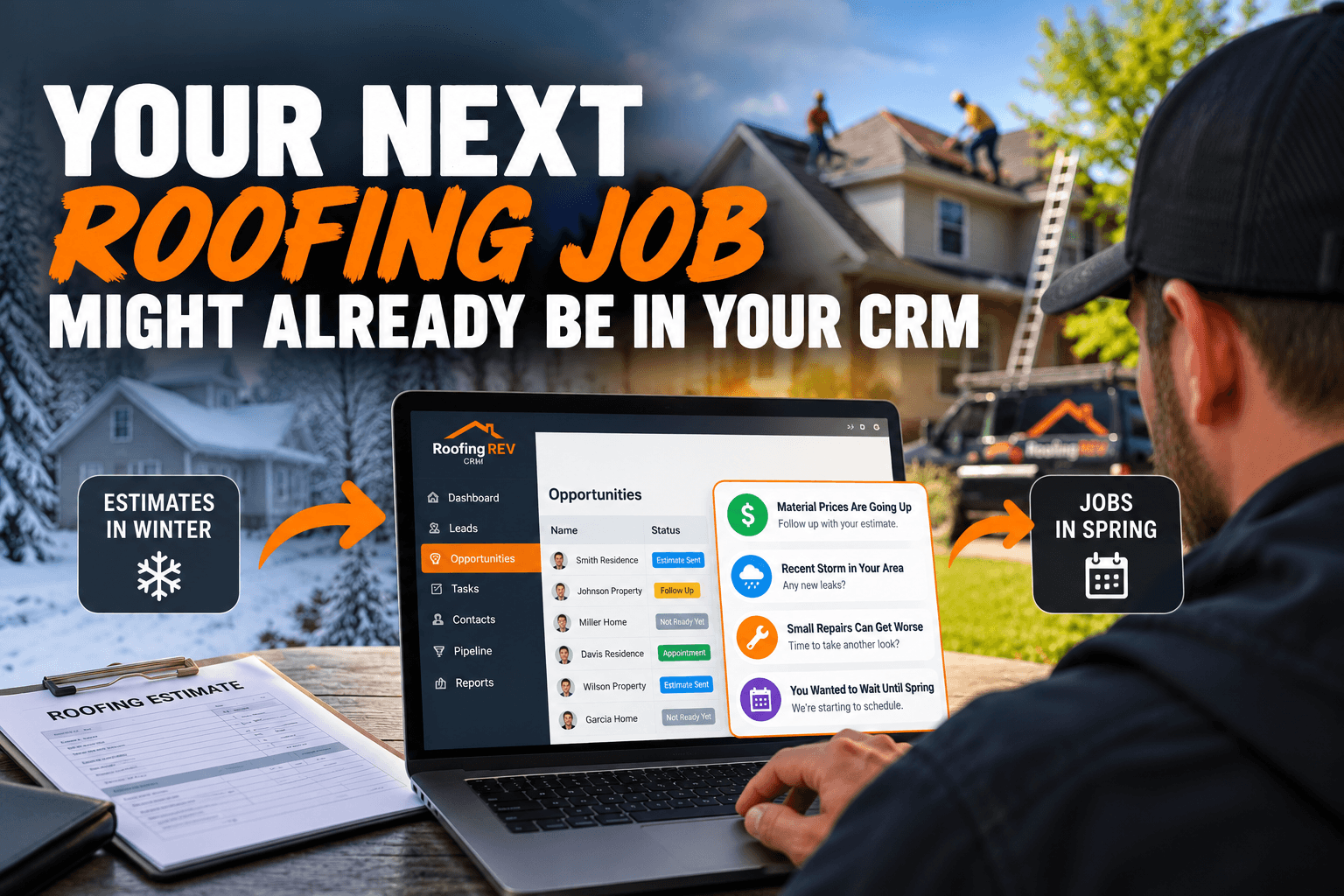
Your Next Roofing Job Might Already Be in Your CRM
What if your next roof replacement didn't require another Google Ad, another website visitor, or another new lead? What if that customer is already sitting in your CRM? Think about it. You've probably got people you never reached, estimates that went unanswered,...

Google’s AI Is Calling Roofing Companies: Here’s How to Respond
Google's AI is no longer just helping property owners find roofing companies. It's now making phone calls on their behalf, asking questions about services, pricing, and availability. One of our roofing clients recently received one of these calls, and it revealed a...
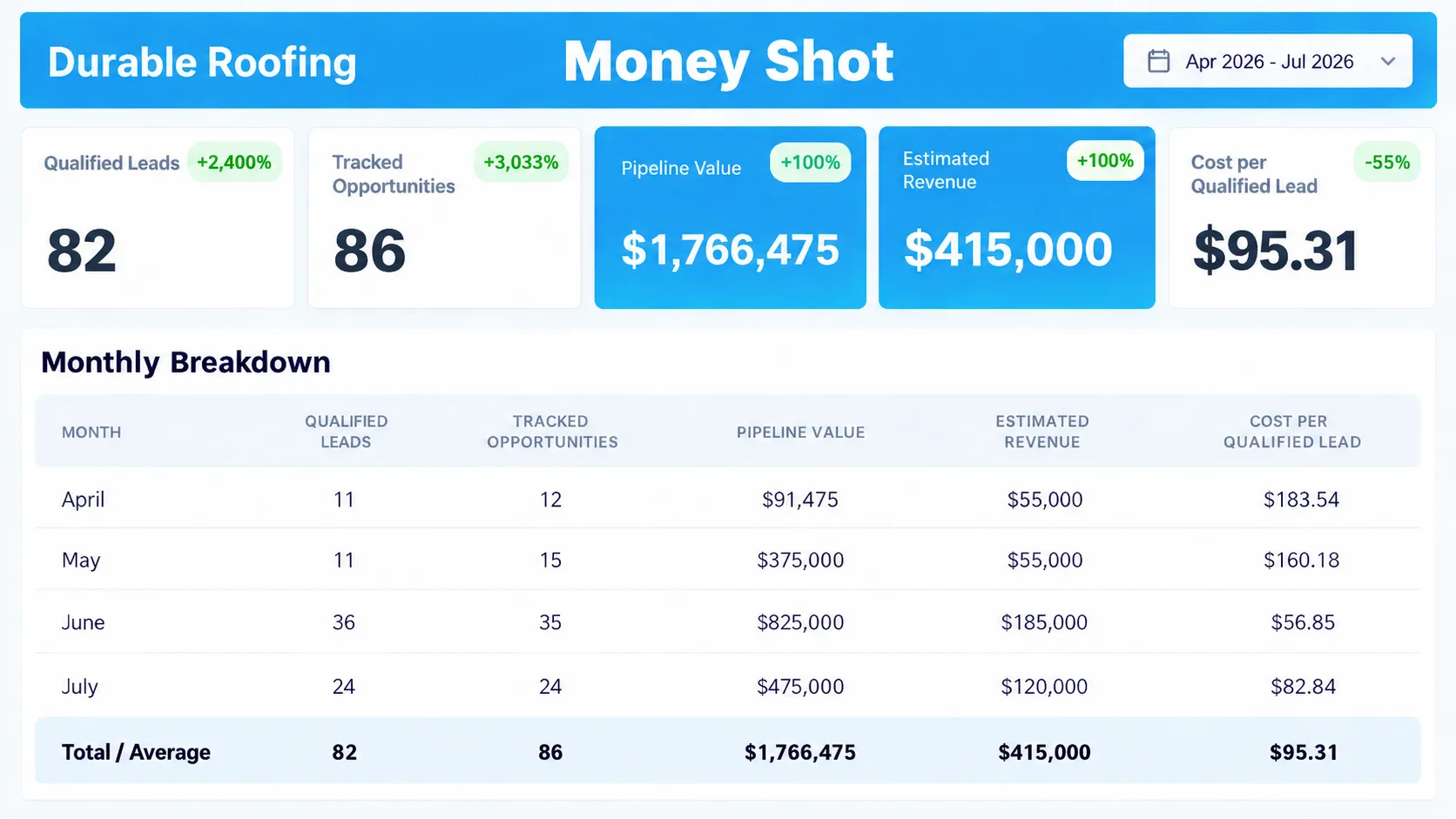
Durable Roofing Generated 82 Qualified Leads Within First 4 Months
Durable Roofing Generated 82 Qualified Leads Within First 4 Months That’s $1.77 Million in Pipeline Value!View More Success Stories > Durable Roofing Generated 82 Qualified Leads Within First 4 MonthsDurable Roofing is a fourth-generation roofing company with more...